Exploring Density: Measuring Solid and Liquid Substances in the Lab
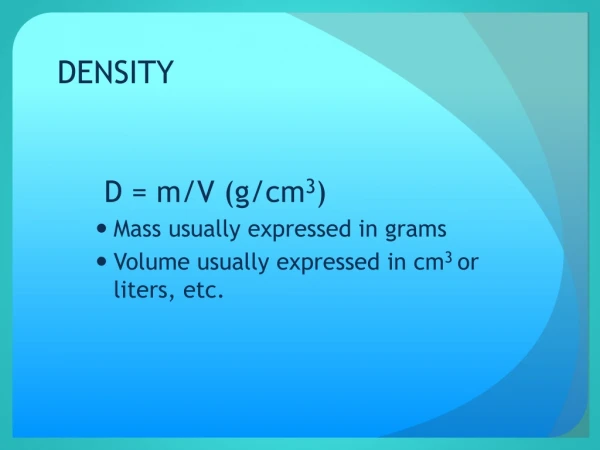
In this experiment, you will determine the density of one solid and one liquid substance, specifically deionized (DI) water, using various equipment available in the lab. Gather data and record it in a data table. After collecting your measurements, analyze the results to identify your solid sample by comparing its density to known values of different materials including aluminum, platinum, copper, tin, titanium, zinc, lead, lithium, acrylic, and glass. Finally, calculate the percent error of your experiment to assess accuracy.


Exploring Density: Measuring Solid and Liquid Substances in the Lab
E N D
Presentation Transcript
Some guidelines… • You will be finding the density of two different substances – one solid and one liquid (DI water). • Record the data in a data table • You are free to use any of the equipment in the open cabinets or on the lab tables. If there is a piece of equipment that you need and cannot find, please let me know.
Analysis • Use the given data table to identify your solid. • Find the percent error of your experiment using the following formula:
Known Density of Unknowns • DI Water 1.00 g/cm3 • Aluminum 2.702 g/cm3 • Platinum 21.45 g/cm3 • Copper 8.96 g/cm3 • Tin 7.26 g/cm3 • Titanium 4.51 g/cm3 • Zinc 7.14 g/cm3 • Lead 11.3 g/cm3 • Lithium .53 g/cm3 • Acrylic 1.21 g/cm3 • Glass 2.58 g/cm3