Mastering Formal Commands in Spanish: A Guide by Emma Haviland-Blunk
This comprehensive guide by Emma Haviland-Blunk details the rules for using formal commands in Spanish, including the third-person subjunctive form and the proper conjugations for -ar, -er, and -ir verbs. Learn to construct affirmative and negative commands, including the correct placement of pronouns. The guide also features common irregular verbs and their transformations in formal commands. Enhance your Spanish language skills with these essential rules for effective communication and formal etiquette.

Mastering Formal Commands in Spanish: A Guide by Emma Haviland-Blunk
E N D
Presentation Transcript
Formal Commands Emma Haviland-Blunk
Formal Commands by Emma Haviland-Blunk
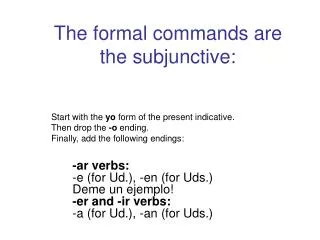
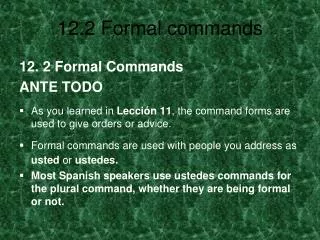
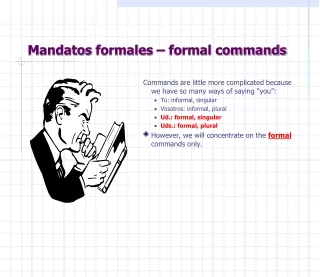
Rules • Use the 3rd person form of the present subjunctive. Or, start with yo form, drop o, and add opposite ud. form ending • -ar verbs: use –e (for ud.) and –en (for uds.) • -er and –ir verbs: use –a (for ud.) and –an (for uds.) • It’s the same for both affirmative and negative commands • Add indirect object pronouns and object pronouns attached to affirmative but before the negative • Using ud. or uds. adds a degree of formality
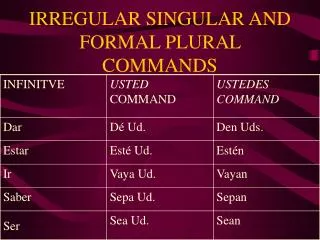
Irregulars • Irregularities of the yo form are carried over Tenga/tengan, cuente/cuenten, vuelva/vuelvan • Other common irregulars: Dar= dé (ud.), den (uds.) Estar= esté, estén Ir= vaya, vayan Ser= sea, sean Saber= sepa, sepan Jugar= juegue, jueguen Buscar=busque, busquen Almorzar= almuerce, almuercen