
A Comprehensive Guide to Library Resources and Online Research
E N D
Presentation Transcript
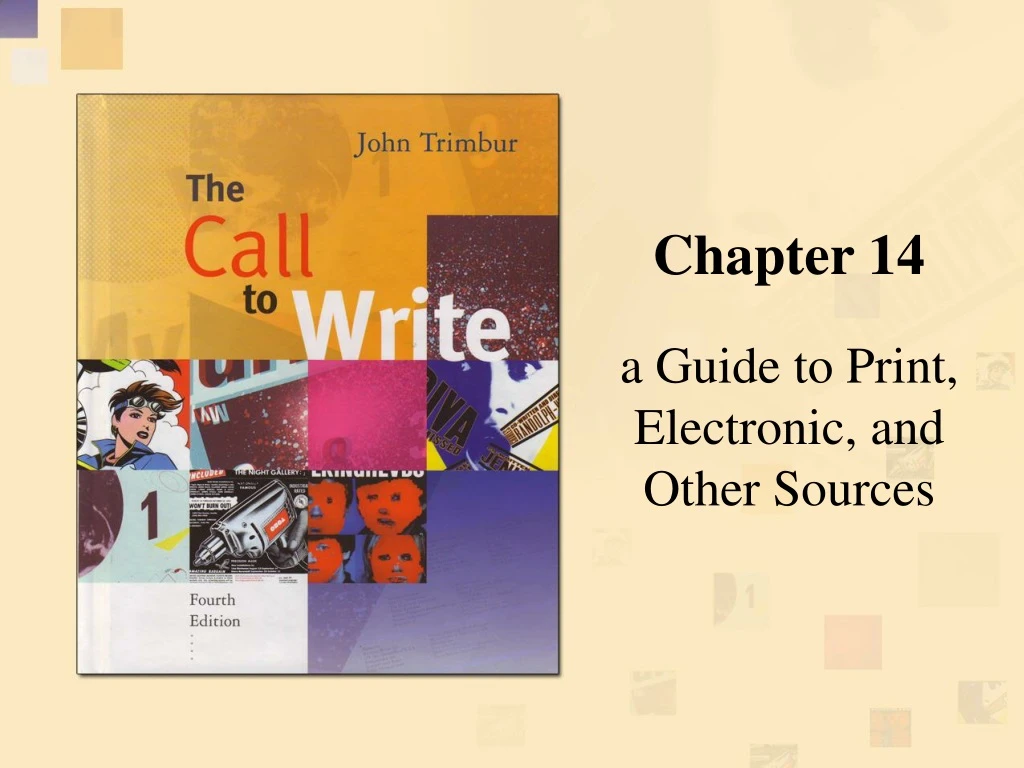
Chapter 14 a Guide to Print, Electronic, and Other Sources
Chapter overview • Looks at the library as a resource Other resources include: • The World Wide Web, discussion boards, and live performances • How to find information in indexes for books, magazines, or newspaper articles • How to use search engines to find information on the Internet
Research begins with the library Traditional print sources include: • Online catalog • Books and reference material • Magazines and journals • Newspapers
New electronic options • Reference materials on CD-ROM (most are available online instead) • Periodical databases such as Ebsco Host • Full-text online journals, newspapers • E-books • Organizational Web sites, many with discussion boards
Three types of books • Scholarly books—published by university presses. Specialized and addressed to academics. • Trade books—published by commercial presses, generally for a broader audience • Other books—published by religious and political presses, nonprofits and professional organizations
Five kinds of periodicals • Scholarly journals with research by scholars (New England Journal of Medicine) • Public affairs magazines (New Yorker) • News magazines (Newsweek) • Trade magazines (Advertising Age) • Popular magazines (Rolling Stone)
The library catalog • The catalog lists the materials (including books and periodicals) in the library. Records are organized by author, title, periodical,and subject. • The old-fashioned card catalog is gone; catalogs are now online.
Periodical indexes • Indexes list articles in magazines and journals; there are three types of indexes. • Those listing the citations only, such as the Readers Guide to Periodicals • Those with abstracts, a brief summary of the contents of the article (Historical Abstracts) • Those with the full text, such as LEXIS/NEXIS or Ebsco Host
Two types of encyclopedias • General: Includes traditional encyclopedias such as World Book, Microsoft Encarta,and Collier’s • Specialized: Refers to encyclopedias that cover a narrow topic, such as literature, education, or philosophy.
Bibliographies • Lists of articles or books on a narrow topic • Annotated: Includes a paragraph summary of each source • Textbook: Mentions the Bibliographic Index, which is published each year, providing a master list of bibliographies
Search engines • See page 473 for a list of Web directories, or search tools. • Search engines such as Google use key words. • Others, such as WebCrawler, are Web directories, organized more like a library catalog.
More search engines • Metasearch engines search multiple search engines at once. • Ask Jeeves is a natural-language search engine. • Hint: once you look these up, save them as favorites (if using Internet Explorer) or bookmarks (if using Netscape Navigator)
Using keywords • See the box on page 473 for tips to finding the right keyword or keyword combination for search engines and electronic databases.
Government sources • Lots of information is available from the government, including a summary of legislation on a weekly and quarterly basis. • See the listing of government publications, on pages 506-507. • http://www.gpoaccess.gov/index.html
Other sources • Performances and events (seminars, lectures, plays, concerts) • Museums • Television, documentary films, radio, and other forms of media
Student Companion Website • Go to the student side of the Web site for exercises, chapter overviews, and links to writing resources for this chapter: http://college.hmco.com/pic/trimbur4e