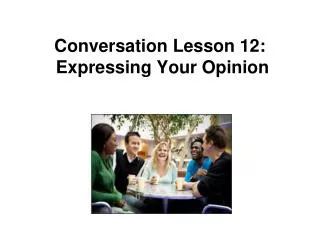
Expressing an Opinion
Expressing an Opinion. Politely. Indirect Opinions. If someone did not ask for your opinion If you do not know the person very well If that person is in a position of authority over you Boss Teacher Parent. Indirect Word Choice. “I think” might, could, would, if


Expressing an Opinion
E N D
Presentation Transcript
Expressing an Opinion Politely
Indirect Opinions • If someone did not ask for your opinion • If you do not know the person very well • If that person is in a position of authority over you • Boss • Teacher • Parent
Indirect Word Choice • “I think” • might, could, would, if • Your friend is thinking about buying a new car. You could say • “I think you should take it to a mechanic to have it checked before you buy it” • “You might take the car for a test drive first” • “If I were buying a new car, I would shop around to make sure this is a good price”
Direct Opinion • If you are being asked to do something you feel is morally wrong or dangerous • If someone is not fulfilling his/her responsibilities at work or school • If you are speaking to a close friend or family member • If the person asked for a direct opinion
Direct Opinion Word Choice • “You should or should not” • “I can or can not” • “You must/have to or must not” • EX. You boss asks you to lie for him because he did not do his work. You say, “I am sorry, but I can not do that. Let’s find another way to solve this problem.” • EX. Your sister asks you if it is OK to change her taxes. You say, “You shouldn’t do that. You could get into trouble with the IRS.”
Indirect / Direct Quick Check • Which of the following shows an indirect or direct opinion? • You shouldn’t get that haircut. • Maybe you could ask for some help. • I cannot do that. • I think that book is not very good.