Download
1 / 4
40 likes | 169 Vues
This guide explores key concepts in Latin verb conjugation, including tense, person, number, and mood. Tense indicates when an action happens (present, past, future), while person denotes the subject perspective. Number signifies singular or plural forms related to verb endings. The mood of a verb reflects the speaker's attitude: the indicative mood presents statements (e.g., "Caecilius quaerit forum"), while the imperative mood conveys commands (e.g., "quaere forum!"). Additional exercises help identify verb moods and translate key Latin phrases.

E N D
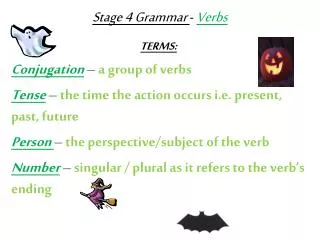
Stage 4 Grammar - Verbs TERMS: Conjugation – a group of verbs Tense– the time the action occurs i.e. present, past, future Person – the perspective/subject of the verb Number – singular / plural as it refers to the verb’s ending
Mood Mood – a verb form that indicates the speaker’s/subject’s attitude toward what is being done/said. • Indicative Mood – indicates a statement/fact e.g. Caeciliusquaerit forum. • Imperative Mood – indicates a command e.g. quaereforum! NOTA BENE: The Vocative Case for Latin nouns is used with the imperative mood. e.g. serve, quaere forum! (The vocative case endings are used to show a noun is being directly addressed/called.)
Practice! DIRECTIONS: Identify the mood of each sentence. Then translate each. • Marcusvocatcanem(in viā.) _____________ • Caeciliī, capimercatorem!_____________ • veniō(ad atrium) et salutōamīcum._________ DIRECTIONS: Identify the case of each underlined noun in the sentences. • Marcusvocatcanem(in viā.) • Caeciliī, capimercatorem! DIRECTIONS: Translate each verb. 1. quaeris - ___________ 2. quaerit - _________ 3. quaerō - ___________ 4. quaere! - _________