Understanding Ionic Bonds: The Basics of Chemical Bonding
Chemical bonds are the essential "glue" that holds atoms together in compounds, like water (H2O). Bonds form through interactions between electrons surrounding atomic nuclei. There are two main types of chemical bonds: ionic and covalent. Ionic bonds occur when atoms gain or lose electrons, creating positive and negative ions. The attractive force between these ions forms ionic bonds, such as in sodium chloride (NaCl), or salt. Understanding the naming convention for ionic compounds helps in recognizing different chemicals, like Barium Iodide from Barium and Iodine.

Understanding Ionic Bonds: The Basics of Chemical Bonding
E N D
Presentation Transcript
Chemical Bonds • Chemical bonds are the “glue” that holds atoms of elements together in compounds. • We can get water because of a chemical bond that holds the hydrogen and oxygen together. • Bonds form when the electrons around the nucleus interact with the electrons from another atom. • It takes two or more atoms to bond.
Chemical Bonds • There are two different types of chemical bonds. • Ionic • Covalent
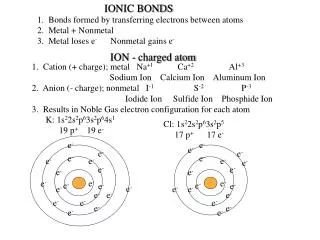
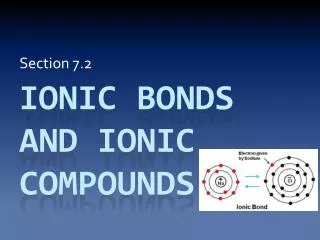
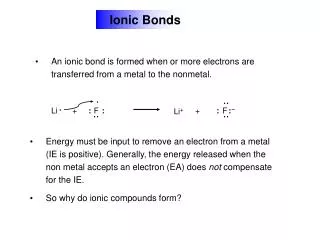
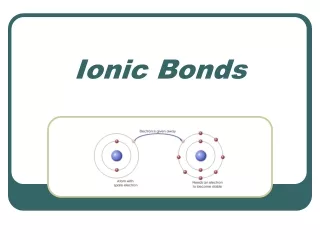
Ionic Bonds • Remember Ions are formed when atoms gain ore lose electrons. • Gain electrons Negative ion • Loose electrons Positive ion • All Metals lose electrons • Non-Metals gain electrons
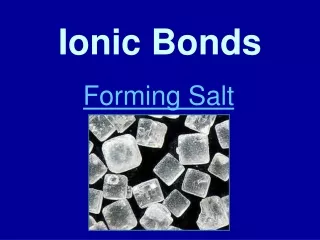
Ionic Bonds • The force of attraction between positive and negative ions is called an ionic bond. • Ex (Na+) (Cl-) NaCl Salt • This attraction happens over and over and over and over and over until eventually we form larger amounts of salt.
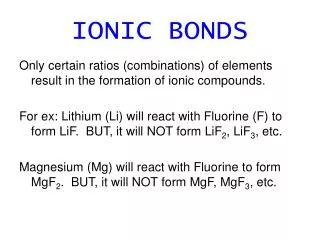
Ionic Bonding Names • 1st – Take the name of the positive ion (metal), leave it as is. • 2nd – Take the negative ion (non-metal) add the ending –ide • 3rd – Combine the two words. • Ex: • Barium – Metal • Iodine – Non-Metal • Barium Iodide