Download
1 / 10
100 likes | 213 Vues
This analysis explores the industrialization process in continental Europe from 1750 to 1913, focusing on key trends such as the growth of railroad tracks and the decline of non-western nations. It examines the various agents that facilitated industrialization, including talented artisans and government support, as well as the major challenges faced, such as the impact of the Napoleonic Wars and technological gaps compared to Britain. The interplay of economic nationalism and strategic investments shaped the continent's industrial landscape, leading to significant changes in Europe's economic dynamics.

E N D
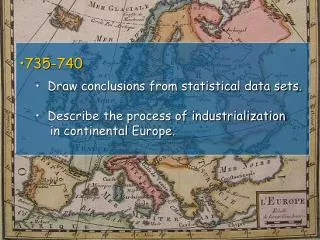
735-740 • Draw conclusions from statistical data sets. • Describe the process of industrialization • in continental Europe.
Quiz: • 2-3 sentence description.
Directions: • Analyze the line graph “Railroad Track Laid” 1840-1900. • Study the other statistics and write a sentence for each that identifies a trend, theme, a conclusion or prediction about the Industrial Revolution. • NOTE: For #3 use the table on page 736…
Industrialization in Continental Europe Atlantic Ocean • In 1750 all European • countries were close in • their level of industry. • Belgium and the U.S. • followed Britain’s lead. • France showed only • gradual growth. • By 1913, Germany and • the U.S. were challenging • Britain’s lead. • As Europe industrialized, • non-western nations de- • industrialized.
Disadvantages of Continental Europe? • Napoleonic Wars devastated the European continent. • British goods were inexpensive. • Industrial enterprises required greater investments. • Workers lacked the technological skills of British workers.
What were the advantagesenjoyed by continental Europe? • Tradition of the “putting-out system. • Could “borrow” technology from Britain. • Strong independent governments. • UNTIL….1825 GB law forbade mechanics and artisans to leave. ….1843 GB declared the export of textile machinery illegal.
What agents brought about industrialization in Western Europe? • Talented artisans, entrepreneurs, mechanics did leave Britain. • William and John Cockrill (son) • Fritz Harkort • European governments provided financial help • Belgium granted funds to support RR construction • France used “tariff protection” • Prussia guaranteed bonds to build railroads • German nationalist Friedrich List promoted “Economic Nationalism” – “Zollverein”.
What agents brought about industrialization in Western Europe? • Talented artisans, entrepreneurs, mechanics did leave Britain. • William and John Cockrill (son) • Fritz Harkort • European governments provided financial help • Belgium granted funds to support RR construction • France used “tariff protection” • Prussia guaranteed bonds to build railroads • German nationalist Friedrich List promoted “Economic Nationalism” – “Zollverein”. • Creation of “limited liability corporations”.