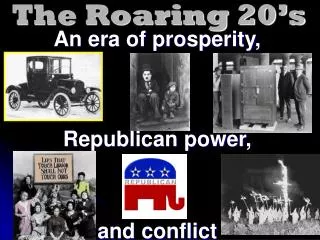
The Roaring 20 s
The Roaring Twenties marked a transformative period in American history characterized by economic prosperity following the 1921-22 recession. The industrial revolution birthed innovations, leading to suburban growth fueled by automobile expansion and the advent of commercial air travel. However, while manufacturing thrived, many workers faced poverty and were replaced by machines. This era also witnessed significant challenges for women and minorities in the job market, with barriers to higher-paying employment. Agriculture saw advancements, but farmers struggled with falling prices despite production increases.


The Roaring 20 s
E N D
Presentation Transcript
The Roaring 20s John Ermer U.S. History Honors Miami Beach Senior High LACC.1112.RH.1.9, SS.912.A.5.1-10, SS.912.A.1-7, SS.912.G.1-3, SS.912.G.4-3
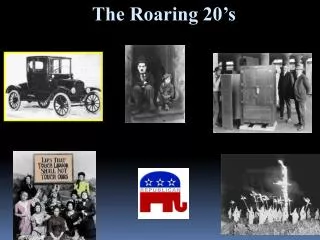
A Booming Economy • Recession of 1921-22 ends, bringing almost a decade of prosperity • The United States emerge only healthy industrial power after the war • Industrial growth funds more innovation and technological expansion • Automobile spurs boom in suburban construction & road building • Commercial Air Travel • Radios, Telephones, Electronics, & Home Appliances • Early research into computers at MIT • Notable Columbia University & Cal Tech geneticist Thomas Hunt Morgan
Labor in the 1920s • Welfare Capitalism • Henry Ford shortens work week, raises wages, offers paid vacations • U.S Steel improves factory safety • “Company Unions” • Company towns/worker housing • Many workers below poverty level, replaced by machines • 1920s not a good time for organized labor, AFL remains weak
Women & Minorities at Work • “Pink Collar Jobs”: low paying service jobs • Like manufacturing, not skilled enough to be organized by AFL • AFL craft jobs actively block participation by African-Americans • In northern cities, African-Americans forced to work low-paying jobs • In the West, Asians & Hispanics blocked from high paying work • 1920: California passes law to prevent purchases of land by Japanese • Mexican barrios develop in Los Angeles, El Paso, San Antonio, Denver • The “American Plan” campaign of union busting
Agricultural technology • Number of tractors triples in the 1920s after the invention of the internal combustion engine, expanding acres under cultivation • Sophisticated combines and harvesters helped produce more crops with fewer workers, many farmer workers out of work • Hybrid crops, chemical fertilizers and pesticides • Demand for food does not keep up with crop production, prices drop • Parity: attempts to set “adequate” price controls on farm goods