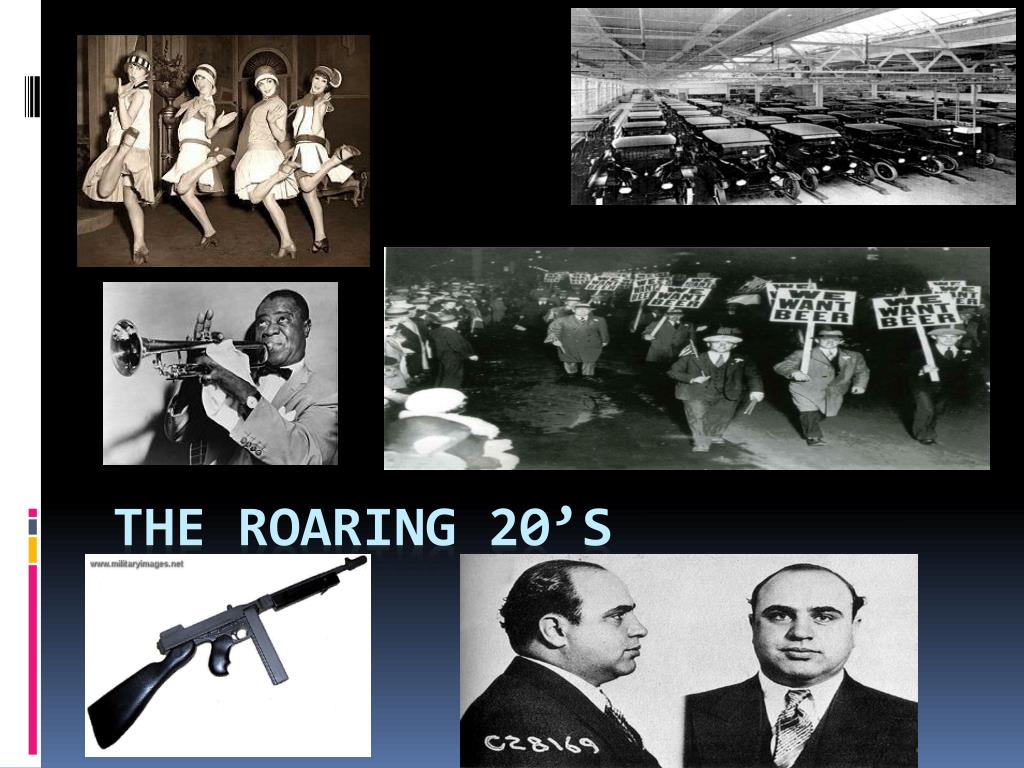
The Roaring 20’s
1920s Overview • The 1920’s laid the foundation for modern America. Many new inventions, new manners of dress and behavior, and new entertainment and leisure activities began in this decade. • Prohibition, the sale of alcohol, was started with the 18th Amendment—yet very few people in urban areas followed the law. • The decade was all about “pushing the boundaries”: technological and social boundaries were shattered as we embraced an urban future. • Often referred to as the “Lost Generation”- innocence lost during the war, driven by greed, materialism, pleasure and shallow
1920’s Slang • What can slang terms tell us about an era? • With your groups, review the packets of 1920’s slang terms and complete the following: • Make a list of all the terms still used today • Which ones surprise you? • What 5 are the ‘best’ in your opinion? • What 5 are the ‘strangest’ in your opinion? • Create a list of 10 slang terms from your generation? • How is your slang similar to and different from the slang of the 1920s? • What slang terms do your parents(or older people) use that you don’t? • Create a quick skit with your group using a minimum of 15 terms from the 1920’s. Give the skit a setting( dance hall, speakeasy, party, school, etc.) Each person should have lines!!!!!!!!!!
Post-War Adjustment • 1.Hardships of WWI • 2. Social unrest/change • 3,600 strikes in 1919 • Bombs mailed to prominent figures(plans foiled) • Simultaneous bombing of 8 U.S. cities(June,2 1919) • 18th-19th amendment • Intense race riots in major cities 1916-1919 • Isolationism: pulling away from world events • People feared: • 1. Immigrants • 2. Communism • 3. Anarchists
Palmer Raids(Red Scare 1919-1920) American’s fear communists and anarchists are operating everywhere! • Attorney General Mitchell Palmer began Palmer Raids • Rounding up suspected communists, deporting and jailing some (without trials) • Claim alleged plot to overthrown the U.S. on May Day 1920 • 600+ deported • 10,000+ arrested
Closing the Doors • Immigration Act of 1917- • but not limited to “homosexuals”, “idiots”, “feeble-minded persons”, "criminals", “epileptics”, “insane persons”, alcoholics, “professional beggars”, all persons “mentally or physically defective”, polygamists, and anarchists. Almost all Asian nations • Emergency Quota Act-1921 • Only 3% of each ethnic group admitted(1910 census) • 805,228 in 1920 to 309,556 in 1921-22 • Immigration Act 1924 (National Origins Act) • Lower Quota- 2%(1890 census) • Japanese Exclusion Act
Sacco and Vanzetti • April 15, 1920 gunmen robbed a shoe factory and killed the paymaster and guard • Sacco and Vanzetti were arrested; they were known anarchists and Italian immigrants • Found guilty and executed in 1927 • Evidence against them was controversial; many felt they were innocent.
Postwar Social Change 1920-1929 Society in the 1920s: Changing Role of Women Flappers-example of a “new woman.” Short dresses, short hair, wore make-up, smoke and drank in public. Not every woman was a flapper. Working Women-women worked low-paying jobs as clerks or office typists in the cities. Employers were still prejudiced towards women. Women Vote- 19th Amendment in 1920. Few women voted early in the decade but laid the foundation for future generations.
Life in the Twenties- • Smoke, drank, loved to dance (rebels!) • Birth Control ^ and Divorces ^ • Kids go to school and peer pressure begins • 1930 51% of children were in school compared to 6% in 1890
Postwar Social Change 1920-1929 Society in the 1920s: American Heroes National Celebrities- Charles Lindbergh was first person to fly solo across the Atlantic. He became instant celebrity Sports Heroes-Sports became big business in the 1920s. Babe Ruth- Most famous player of the 1920s. Hit 60 homeruns for the Yankees in 1927. Jack Dempsey- Heavyweight champion of the world. First boxer to earn $1 million.
Postwar Social Change 1920-1929 Mass Media and the Jazz Age Mass Media Radio- Early radio broadcast reached only local audiences. Broadcasts go national by end of the 1920s Results- National networks, advertising becomes prominent, created national culture, music increased in popularity, sports broadcasted, spreads news quickly Movies- Silent movies until 1927 (The Jazz Singer). California becomes movie capital (no rain) Results- Breaks down ethnic barriers to create national culture.
Postwar Social Change 1920-1929 Society in the 1920s: Americans on the Move Great Migration-Movement of African-Americans from the South to industrial centers of the NE and Midwest Causes- Decreased cotton prices, lack of immigrant labor, war industries Effects- Higher wages, more educational opportunities, and better standard of living for African-Americans Negatives- Race Riots and growth of the KKK
Postwar Social Change 1920-1929 Mass Media and the Jazz Age Mass Media Writers- Many were affected by WWI and had some pent up anger. Reflected the 1920s spirit of rebelling against social norms. Collectively known as the Lost Generation F. Scott Fitzgerald- The Great Gatsby—commentary on the illusion of the American Dream. Ernest Hemingway- Served in WWI and wrote about the war (Farewell to Arms, The Sun Also Rises) 13
Postwar Social Change 1920-1929 Mass Media and the Jazz Age Jazz Age- Popular urban music of the 1920s. Started in New Orleans and moved North during the Great Migration. Created by and performed mostly by African-American artists, including Duke Ellington, Louis Armstrong, and “Jelly Roll” Morton. 14
Postwar Social Change 1920-1929 Mass Media and the Jazz Age Harlem Renaissance-Growth of African-American Arts and Literature. African American Literary and Artistic Movement-stressed cultural pride Writers- Zora Neale Hurston and Langston Hughes were the most popular.
Postwar Social Change 1920-1929 Cultural Conflicts: Every Action Has a Reaction Prohibition- 18th Amendment prohibited the manufacture, sale, transport, or consumption of alcohol Volstead Act- Defined alcoholic beverages and imposed criminal penalties South- Favored, wanted to keep alcohol out of the hands of African-Americans West- Favored, wanted to keep public intoxication, prostitution, and crime under control East- Not favor, mostly ignored by foreign born city dwellers Enforcement- Mostly ignored. Poor punished more than rich, cops open to bribery
Postwar Social Change 1920-1929 Cultural Conflicts: Every Action Has a Reaction Prohibition- lawbreakers Speakeasies- “secret” clubs that sold illegal alcohol Bootleggers- someone who makes or sells illegal liquor Moonshiners- homemade alcohol suppliers (bathtub gin) Gangsters- Bootlegging led to bribery and violence. Chicago in the 1920shad 500 gangsters murdered Al Capone- Head of the Chicago Syndicate. Eliminated Irish competitors on 2/14/1929
Postwar Social Change 1920-1929 Cultural Conflicts: Every Action Has a Reaction Fundamentalism- A rigid view of religion and literal interpretation of the Bible. Threatened in the 1920s by science. Scopes Monkey Trial- Fundamentalists vs. Modernists Results- Scope was found guilty but the Fundamentalists lose in the long term. Increasing number of Christians come to reconcile science and religion.
Scopes Trial aka The Monkey Trial (1925) • Dayton, Tennessee • John T. Scopes a substitute biology teacher agrees to include evolution in the curriculum (backed by the ACLU) • Challenged the Butler law • Trial is a national sensation • Creationism vs. Evolution • Clarence Darrow (Scopes lawyer) vs. William Jennings Bryan(prosecuting lawyer) • Scopes fined $100(a lot), later overturned
Postwar Social Change 1920-1929 Cultural Conflicts: Every Action Has a Reaction Racial Tensions- Reaction to the rising social status of African-Americans Race Riots- Violent reaction to the Great Migration. 1919 known as Red Summer as riots breakout in major cities (Chicago, Omaha, E. St. Louis) Return of the Klan- Returns in the 1920s and spreads to the Midwest. Capitalized on resulting tensions caused by the Great Migration. Membership peaks in 1925 at 5 million members. United Negro Improvement Association- Founded by Marcus Garvey to promote African-American self-reliance, self-confidence and the resettlement of the Africa.
Ku Klux Klan • Inspired by the film, The Birth of a Nation • William J. Simmons revived the Klan(Imperial Wizard) • Devoted to 100% Americanism-Appeal to patriotic WASP’s • Anti-Jewish, immigrant, Catholic, communist, black • Reached 4 million members • KKK didn’t have to pay taxes and charged $10 to be a member, so they became rich
KKK Cont. • Violent!- Lynching, killing, shooting, whipping, branding, tar, and feather, etc. • Police and judges ignored violence Postcard of 1920 Duluth lynching
Presidents of the 1920’s Warren G. Harding (1921-1923 #29) Calvin Coolidge (1923-1929 #30)
Warren G. Harding • Pledge a “return of normalcy” • Established Bureau of Budget to make gov’t fiscally responsible • Cut taxes, raised tariffs, reduced debt, helps farmers • Cabinet was mostly his poker buddies, “Ohio Gang, “ and most were corrupt • Teapot Dome Scandal- Secretary of interior, Albert Fall, leased gov’t oil reserves to private companies and took money; found guilty • Harding died before scandal became public knowledge (slightly mysteriously)
Calvin Coolidge: Business of government is Business • Passed Dawes Plan: loaned $ to Germany so they could pay France (did to avoid war) • Passed Kellogg-Briand Pact: a treaty to outlaw war. It failed to include punishments for future attacks • Main business of people is business; pledge prosperity: extremely pro-business • Reduced taxes, wages ^ 35%, productivity ^