SlideServe
Menu
Préférences
© SlideServe · v2026

Mastering DC Circuits: Concepts and Application

paul-mcintyre avatar
4 diapositives · 157 Views · Nov 16, 2014

Dive into Chapter 27 as we explore DC circuits, covering topics such as electromotive force, Kirchhoff’s rules, resistors, and RC circuits. Work, energy, and emf are discussed, along with calculations in single-loop circuits.
Mastering DC Circuits: Concepts and Application - slide 1
01 / 4Mastering DC Circuits: Concepts and Application
1 / 17

Télécharger la présentation

Mastering DC Circuits: Concepts and Application
Une image / un lien ci-dessous est fourni (tel quel) pour télécharger la présentation

Politique de téléchargement : le contenu du site vous est fourni TEL QUEL pour votre information et votre usage personnel ; il ne peut être vendu, concédé sous licence ni partagé sur d’autres sites sans l’accord de son auteur.Le contenu vous est fourni TEL QUEL, pour votre information et votre usage personnel uniquement. Téléchargez la présentation en cliquant sur ce lien. Lors du téléchargement, si vous ne parvenez pas à télécharger une présentation, l’éditeur a peut-être supprimé le fichier de son serveur.Pendant le téléchargement, si vous ne parvenez pas à obtenir une présentation, le fichier a peut-être été supprimé par l’éditeur.

F I N

Plus de contenu associé

Transcription de la présentation
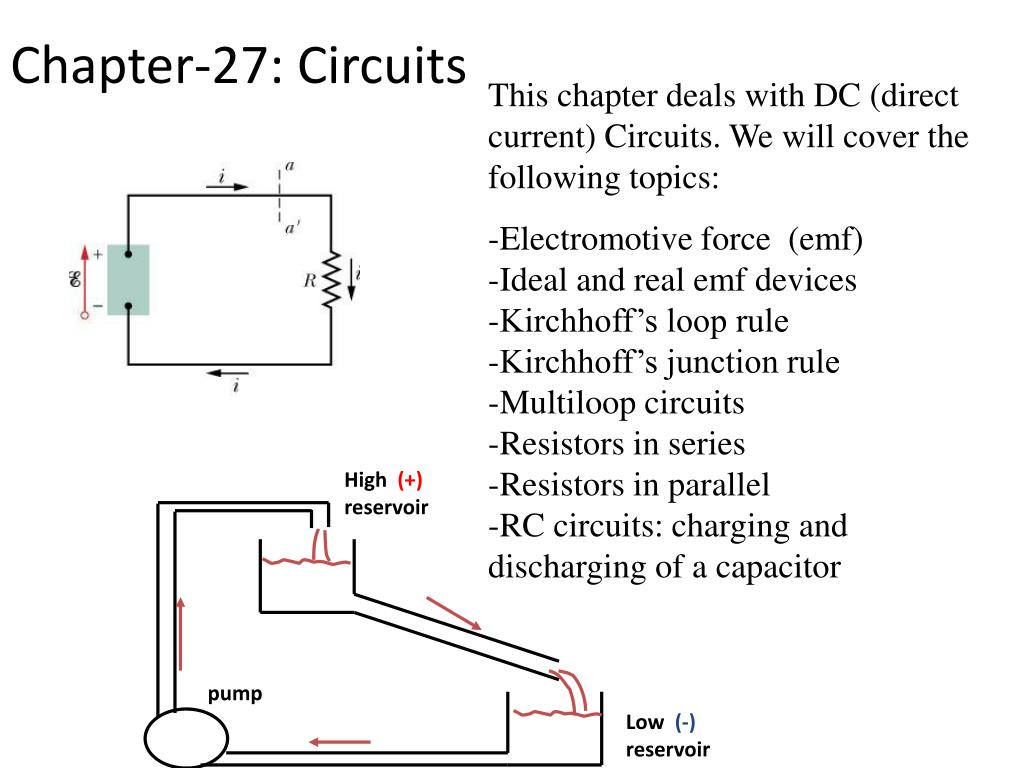
  1. High (+) reservoir pump Low (-) reservoir Chapter-27: Circuits This chapter deals with DC (direct current) Circuits. We will cover the following topics: -Electromotive force (emf) -Ideal and real emf devices -Kirchhoff’s loop rule -Kirchhoff’s junction rule -Multiloop circuits -Resistors in series -Resistors in parallel -RC circuits: charging and discharging of a capacitor

  2. Work, Energy, and Emf A simple electric circuit, in which a device of emf does work on the charge carriers and maintains a steady current i in a resistor of resistance R. In any time interval dt, a charge dq passes through any cross section of this circuit, such as aa′. This same amount of charge must enter the emf device at its low-potential end and leave at its high-potential end. The device must do an amount of work dW on the charge dq to force it to move in this way. We define the emf of the emf device in terms of this work: An ideal emf device is one that lacks any internal resistance to the internal movement of charge from terminal to terminal. A real emf device, such as any real battery, has internal resistance to the internal movement of charge.

  3. Calculating the Current in a Single-Loop Circuit Energy Method Potential Method Kirchhoff’s LOOP RULE: The algebraic sum of the changes in potential encountered in a complete traversal of any loop of a circuit must be zero. Potential Rise = Potential Drop or Potential Rise – Potential Drop = 0

  4. Other Single-Loop Circuits b. Resistances in Series a. Internal Resistance