Sequential Resonance Assignment Strategies for NMR Analysis of Protein Structures
This guide explores sequential resonance assignment methods for NMR analysis of proteins. It covers practical issues in assigning protein backbone atoms (N, HN, CA, HA, CB, HB, C) and side chains, as well as identifying NOE contacts. The text outlines strategies for organizing amino acids, utilizing sequential and structure-specific assignments, and determining tertiary structures through intraresidue and medium-range NOE data. It also discusses heteronuclear assignments to enhance protein folding studies and refine structural calculations using long-range NOEs.

Sequential Resonance Assignment Strategies for NMR Analysis of Protein Structures
E N D
Presentation Transcript
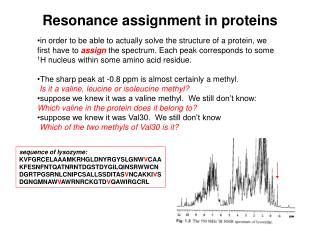
Resonance Assignment • NMR analysis of proteins • Sequential resonance assignment strategies • Practical Issues
Sequential Assignment 1.Assign the protein backbone N, HN, CA, HA, CB, HB, C 2. Assign sidechains 3. Assign NOE contacts
Assignment Strategy • Identify resonances for each amino acid • Put amino acids in order • - Sequential assignment • (R-G-S,T-L-G-S) • 3. Place fragments in aa sequence • - Sequence-specific assignment
A B C D • • • • Z Put Residues In Sequence Use only these to make sequential assignments Tertiary Structure Sequential Intraresidue Medium-range (helices)
Sequential NOEs a-helix :HN(i-1) -> HN(i) b-strand Ha(i-1) -> HN(i)
NOE based Assignment 15N edited 1H-1H TOCSY/NOESY
Large Scalar Couplings Less Sensitive to MW of the Protein Superior to 1H homonuclear strategy: H-H couplings <20 Hz Mixing is faster so less time for signal to relax
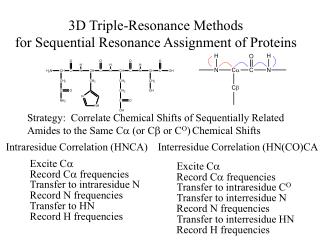
Heteronuclear Assignments:Backbone Experiments Names of scalar experiments based on atoms detected Acquired in ‘pairs’
Determining Protein FoldIn Structure Calculations • 1. Determine secondary structure • CSI directly from assignments • Medium-range NOEs • 2. Add key long-range NOEs to fold
Identify more NOEs In the course of refinement