Advanced Techniques in Protein Analysis: From SDS-PAGE to Mass Spectrometry
260 likes | 375 Vues
This resource outlines various sophisticated methods for protein analysis, emphasizing their applications in biochemistry and molecular biology. Key topics include the use of electrophoretic mobility and frictional coefficients in polyacrylamide gel electrophoresis (PAGE), the principles of isoelectric focusing, and Mass Spectrometry techniques such as MALDI-TOF and ESI. Additionally, it covers methods like Edman degradation, cDNA cloning, and hybridoma cell ELISA. The insights provided improve sensitivity and resolution in protein studies and are essential for various research applications.


Advanced Techniques in Protein Analysis: From SDS-PAGE to Mass Spectrometry
E N D
Presentation Transcript
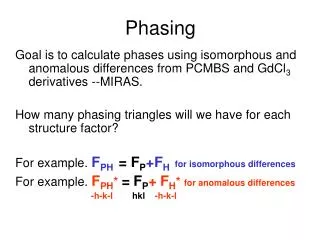
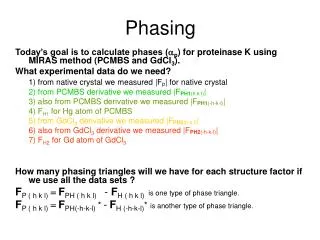
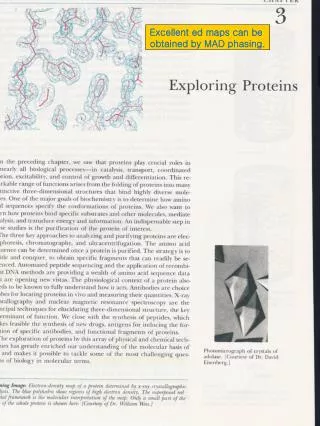
Excellent ed maps can be obtained by MAD phasing.
Electrophoretic mobility Frictional coefficient Polyacrylamide gel Use fresh ammonium persulfate.
Discontinuous buffer system SDS-PAGE Stacking gel Resolving gel
log Mr SDS-PAGE 1. pI (isoelectric focusing) 2 Mr (SDS-PAGE)
DEAE- CM- affinity column Gel filtration column: long Ion exchange column: medium Affinity column: small Concanavalin A
Centrifugal force Sedimentation velocity Sedimentation coefficient 1 S=10-13 sec
MALDI TOF Matrix Assisted Laser Desorption Ionization Time-of-Flight ESI Mass Spectrum
One cycle of Edman degradation Mixture of PTH-aa’s
Performic acid oxidation and cleavage of -S-S- N-terminal sequencing Degenerate oligomer primer cDNA cloning DNA sequencing
4 Ca2+ binding motifs in calmodulin Hybridoma cell
Imaging plate (IP) is 50-times more sensitive than X-ray film. Western blotting Actin filaments
Gold cluster-conjugated antibody Secondary structure content
Low resolution High resolution
Chemical shift When R < 5 A R
Natural Synthetic 항이뇨성의 DCC