Pythagorean Theorem
80 likes | 177 Vues
Explore the Pythagorean Theorem using hands-on activities with right triangles. Learn the key components of right triangles: two legs and one hypotenuse. Cut out identical right triangles, label the sides as 'a', 'b', and 'c', and visually see how the areas relate. By arranging these triangles, you will discover that ( a^2 + b^2 = c^2 ) holds true for all right triangles. Test the theorem with different leg lengths, and apply it to solve real-world problems, reinforcing your grasp of this fundamental concept.


Pythagorean Theorem
E N D
Presentation Transcript
Pythagorean Theorem 5-5-2
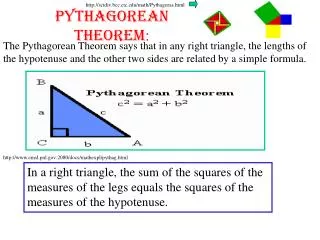
Right Triangle • 90 degree angle • Two short sides called legs • One longer side called HYPOTENUSE
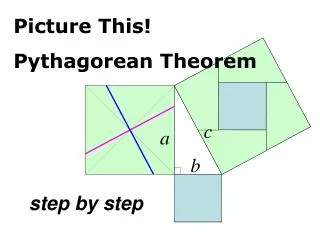
See for yourself • Cut out four identical right triangles • Label hypotenuse c • Label one leg a • Label the other leg b on all triangles
See for yourself • Arrange them
See for yourself • Trace and cut out the large square in a different color. • The red that shows through has an area c2
See for yourself • Move the triangles as shown • Now the red that shows through is a2 +b2
a2+b2=c2 • This works for all right triangles. • What part of the demonstration used the fact that we are dealing with right triangles? • A triangle with legs 40 in. and 42 in. would have what measurement for the hypotenuse?
a2+b2=c2 • What is the measurement of a leg of a right triangle if one leg is 30 ft and the hypotenuse is 34 ft?