Deviance and Social Control
This chapter explores the complex nature of deviance, defined as behaviors that deviate from societal or group norms, including criminal acts and non-conformity in sexual orientation. It distinguishes between negative deviance, which violates ethical standards (e.g., murder, lies), and positive deviance, where individuals conform excessively, leading to issues like eating disorders. The concept of social control is discussed, highlighting internal mechanisms (developed through upbringing) and external mechanisms (societal pressures, gossip, and legal consequences) that promote adherence to societal norms.

Deviance and Social Control
E N D
Presentation Transcript
Deviance and Social Control Chapter 7 Section 1
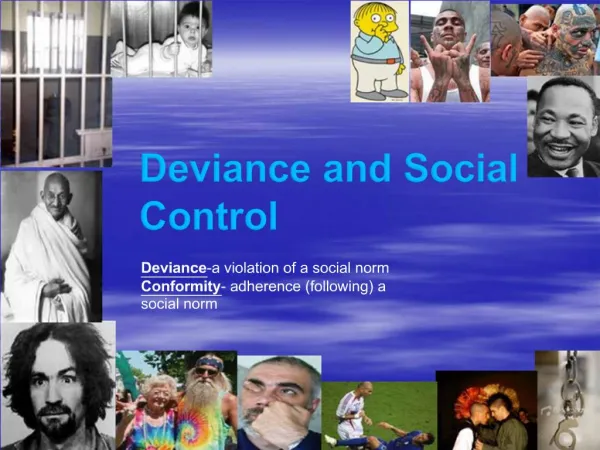
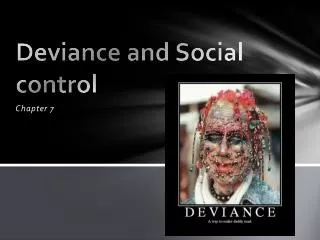
Nature of Deviance • Deviance – a behavior the departs from societal or group norms- criminal behavior to being gay • Very hard to distinguish in our society • Negative Deviance – Behavior that breaks/goes against what societies norm says is right or wrong-these are the killings, lies, rape, murder • Positive Deviance – behavior that over conforms to the norm (society says small is good so a person develops a eating disorder) - anorexia
Deviant – a person who breaks one or more significant societal norms-serious criminals • They are punished for the negative behavior (they must be punished)
Social Control • Social Control – how we promote or make sure that people stick to the norms- Why we walk in front of cars at red lights, let waiters/waitresses give you your food • 2 Types: • Internal Social Control – Happens when you grow up (parents, friends create this). Reason you don’t steal • External Social Control – ways society controls you- Gossip, jail, fines, low grades, smiles, awards, bonuses