Exploring the Dilemmas of War Avoidance and Political Appeasement
This analysis delves into two critical perspectives on conflict avoidance and political appeasement. The first, advocating for dialogue and collaboration even with dictators, highlights its strengths in preventing war but also its potential weaknesses. The second, Winston Churchill's view on appeasement, compares feeding crocodiles to negotiating with aggressors, questioning the morality and effectiveness of such strategies. This discussion evaluates the origins, purpose, and value of these insights while acknowledging their limitations, framing them within contemporary political discourse.

Exploring the Dilemmas of War Avoidance and Political Appeasement
E N D
Presentation Transcript
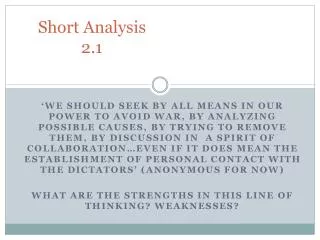
Short Analysis 2.1 ‘We should seek by all means in our power to avoid war, by analyzing possible causes, by trying to remove them, by discussion in a spirit of collaboration…even if it does mean the establishment of personal contact with the dictators’ (Anonymous for now) What are the Strengths in this line of thinking? Weaknesses?
Short Analysis2.2 In Reference to Neville Chamberlain, Winston Churchill said: ‘An appeaser is one who feeds the crocodile hoping it will Eat Him Last.’ Is this a fair statement? Why or Why Not?
Origin—where did the source come from? • Purpose—why did the author choose to write on that topic? • Value—discuss why you think this source is important • Limitations—explain why a source is good to use but isn’t the final word on the issue Phase Three
For Practice: What is the O? What’s the P? What ‘s the V? And the L? Political Cartoon from Der Sturmer
And this one? The Origin? Purpose? Value? Limitation Printed in the Haaretz Daily News, from Jerusalem
O P V L