Download
1 / 31
310 likes | 430 Vues
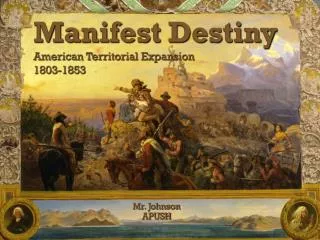
Manifest Destiny was the belief that American settlers were destined to expand across the continent, reaching the Pacific Ocean. Prominent figures like John L. O'Sullivan articulated this vision, emphasizing the nation’s right to spread across the land for the benefit of its growing population. Artwork from this era, such as "Daniel Boone Escorting Settlers through the Cumberland Gap" by George Caleb Bingham, "Westward The Course Of Empire Takes Its Way" by Emanuel Leutze, and "American Progress" by John Gast, provides insight into American attitudes toward western expansion. These paintings illustrate the optimism and complexities of this belief.

E N D
What is Manifest Destiny? • widely held belief that American settlers were destined to expand across the continent • It is the United States’ destiny to expand all the way West (to Pacific Ocean) • John L. O’Sullivan: “Our manifest destiny is to overspread the continent allotted by Providence for the free development of our yearly multiplying millions.”
What can artwork tell us about Americans’ attitudes toward Western Expansion?
Evidence: Three Paintings • Daniel Boone Escorting Settlers through the Cumberland Gap by George Caleb Bingham in 1851-52 • Westward The Course Of Empire Takes Its Way by Emanuel Loetze in 1861 • American Progress by John Gast in 1872
Inferences Observations
Observing • What do you see? • Slow down • Focus on details • Don’t worry about significance/relevance • Involve all 5 senses
Inferences • Use background knowledge • Use observations • Keep it simple • Connect observations and inferences