The Amendment Process: Understanding Changes to the U.S. Constitution
The U.S. Constitution outlines a structured process for amending itself, involving both Congress and state legislatures. Amendments can be proposed through a two-thirds vote in both houses of Congress or by a national convention called by two-thirds of the states. To ratify an amendment, three-fourths of the state legislatures or special ratifying conventions must approve it. Key historical amendments, like the 21st, illustrate this process. Additionally, informal changes through legislation, judicial review, and evolving presidential roles further demonstrate how the Constitution adapts over time.

The Amendment Process: Understanding Changes to the U.S. Constitution
E N D
Presentation Transcript
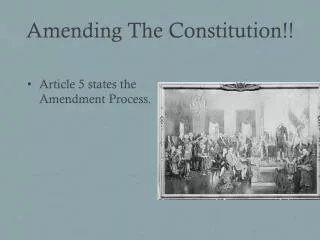
Process • Congress and sates have ability to amend • All topics can be considered except for state representation in Senate • 2 ways to propose • 2/3 vote by each house of congress • A national convention called by congress at the request of 2/3 of the states • Almost happened twice- 1967, 1991
Ratifying (approving) • Legislatures of ¾ of the states ratify or pass the amendment • States call for a special ratifying convention and ¾ of the convention pass it. • If state rejects ratification- it can come back later and reverse its position • Convention held once- 21st Amendment which repealed the 18th and Prohibition
Informal changes • Congress has made laws describing and expanding role of government • Taxes- “lay and collect taxes”???? • Expanded role of executive office • Cabinet secretaries, czars, agencies, etc….. • Expanded size of the judiciary- more courts as country grew. • Government growth- necessary???
Changes through practices • Impeach- accuse federal officials of high crimes and misdemeanors. • Bribery/Treason • Congress has investigated over 60 people • 3 Presidents- Andrew Johnson, Richard Nixon, Bill Clinton
Informal Presidential changes • 1841- William Henry Harrison dies in office • Vice President John Tyler assumed power as provided in Constitution • 1967 25th amendment clarified succession • Treaty vs Executive agreement • Founders felt the executive would concern itself mainly with domestic affairs • Today- very much international
Court decisions • Judicial review- interpret constitution • Judicial restraint- avoid issues social/political questions. Let congress and Constitution establish laws • Judicial activism- court should help shape policies • Warren Court 1953-1969 • Activism- civil rights/social issues
Court can change rulings • Plessyvs Ferguson 1896 • Brown vs Board of Education overturned/overruled in 1954 • Roe v Wade 1973- may see in future