Download
1 / 8
80 likes | 273 Vues
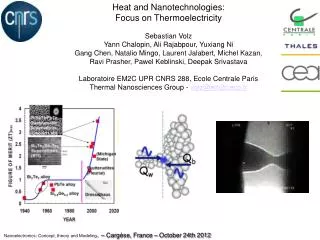
This discussion focuses on thermoelectricity, the generation of electric power through temperature gradients, particularly via the Seebeck effect. As global warming and finite fossil fuel resources prompt the search for new energy sources, thermoelectric materials, especially Bismuth Telluride, have emerged as viable options for recycling lost heat. However, achieving high efficiency in these materials presents challenges due to the need for both electrical conductivity and thermal insulation. This exploration aims to refine energy usage and apply thermoelectric principles to everyday temperature gradients for sustainable power generation.

E N D
Implementing Thermoelectricity AbdulrahmanFakhroo Gino Rumhein
The Energy Epidemic • Global warming • Fossil fuels are finite • Solutions: • New energy sources • Refine the way we use energy
What is Thermoelectricity? • Thermoelectricity is in essence electric power produced by a temperature gradient • The Seebeck Effect • Inverse of the Peltier Effect
Theory • Kelvin-Planck statement: • Two temperature reservoirs needed • Therefore, 100 percent efficiency is impossible • Our aim: • To recycle Qc
Difficulties • Material that is thermally conductive but not electrically conductive • Seebeck coefficient of material must be high • Seebeck coefficient: • Measure of an induced electric voltage as a result of a temperature difference across a material • A measurement of the thermoelectric efficiency of a material:
Bismuth Telluride • Many thermoelectric properties present • Ideal for refrigeration and portable power generation • High Seebeck coefficient … which comes with a price
Calculations • A calculation of the voltage derived from a temperature difference within a material can be given by: • V(t) • Where S is the Seebeck coefficient given as a function of temperature
Application • Applying the thermo electric effect on daily temperature gradients using Bismuth Telluride, can we recycle the lost heat transfer of various thermodynamic cycles?