Download
1 / 16
160 likes | 301 Vues
This project aims to improve the understanding, measurement, and reporting of the quality of population estimates at the local authority (LA) level. We utilize a mixed-methods approach combining census data, administrative sources, and surveys to obtain annual population estimates. Key components influencing uncertainty include internal and international migration, for which we provide a comprehensive error analysis. The resulting quality measures will allow LAs to assess and enhance their estimates, fostering better data-driven decision-making.

E N D
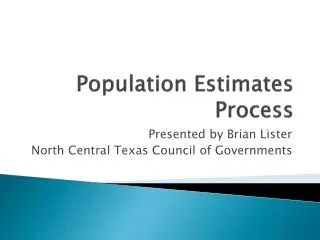
Measuring Uncertainty inPopulation Estimatesat Local Authority Level Ruth Fulton, Bex Newell, Dorothee Schneider
Outline • Project aim • Overall method • Method internal migration • Method international migration • Outputs
Project aim Improve understanding, measurement and reporting of the quality of population estimates at LA level • Obtain overall quality measures for annual population estimates at LA level
Mid-Year Population Estimates • Cohort component method • Pop.(t) = pop.(t-1)+ births • – deaths + internal net migration + international net migration • Determining associated uncertainty is complex • Mixed sources: Census, administrative sources, surveys • Different estimation methods
Error (t) = error (t-1) • + error (net internal migration) • + error (net international migration) Measuring uncertainty: Overall method • Components with biggest impact: • 2001 Census-based estimate • Internal migration • International migration • Estimate distribution of error for component • Combine error estimates into overall quality measure for MYE at LA level
Internal migration • Estimates based on GP registration data • Sources of uncertainty in estimates related to: • Migrants missing from GP register • Time lags between moving and re-registration • Double counting of school boarders
Method for internal migration • Benchmark approach • Uses adjusted 2001 Census data as benchmark • Applies model from 2001 to subsequent years • Limitation – does not cover all quality issues
Method for internal migration (ctd.) • Movers in Census: those with other address one year ago • Movers in PRDS: those with different addresses in two downloads • Census data adjusted to be as similar to PRDS data as possible • Compare observed number of migrants to a ‘true’ number of migrants • Error represented by scaling factor of truth (Census)/PRDS
Age pattern • log(Census/PRDS) • shows double counting of school boarders • shows undercount of young male migrants
Mean log(Scaling Factors)Inflows Geographical variation • Scaling factors vary by area • Undercount in urban areas or areas with high proportion of students • Cluster analysis
Model • Fit model to log of scaling factors of groups of LAs • Obtain predicted values and residuals Error measure is obtained by simulating from this distribution
International migration • Focuses on intentions-based IPS estimates • Multi-stage approach to distribute to national estimates to lower levels of geography
International migration (ctd) • Produce error distribution for statistical error • Bootstrapping approach • Resampling IPS • Resampling LFS (regional level) • Reproduce estimation method with new samples
Outputs Outputs • Composite quality measure will be derived from the overall error distribution • LAs will be banded based on this measure
Contact dorothee.schneider@ons.gsi.gov.uk imps@ons.gsi.gov.uk Questions?