Explore the Limbic System, its structures, functions, and connections, influencing emotions, memory, and behavior. Learn about the role of the hippocampus and the formation of memories.
Une image / un lien ci-dessous est fourni (tel quel) pour télécharger la présentation
Politique de téléchargement : le contenu du site vous est fourni TEL QUEL pour votre information et votre usage personnel ; il ne peut être vendu, concédé sous licence ni partagé sur d’autres sites sans l’accord de son auteur.Le contenu vous est fourni TEL QUEL, pour votre information et votre usage personnel uniquement.Téléchargez la présentation en cliquant sur ce lien.Lors du téléchargement, si vous ne parvenez pas à télécharger une présentation, l’éditeur a peut-être supprimé le fichier de son serveur.Pendant le téléchargement, si vous ne parvenez pas à obtenir une présentation, le fichier a peut-être été supprimé par l’éditeur.
F I N
Plus de contenu associé
Transcription de la présentation
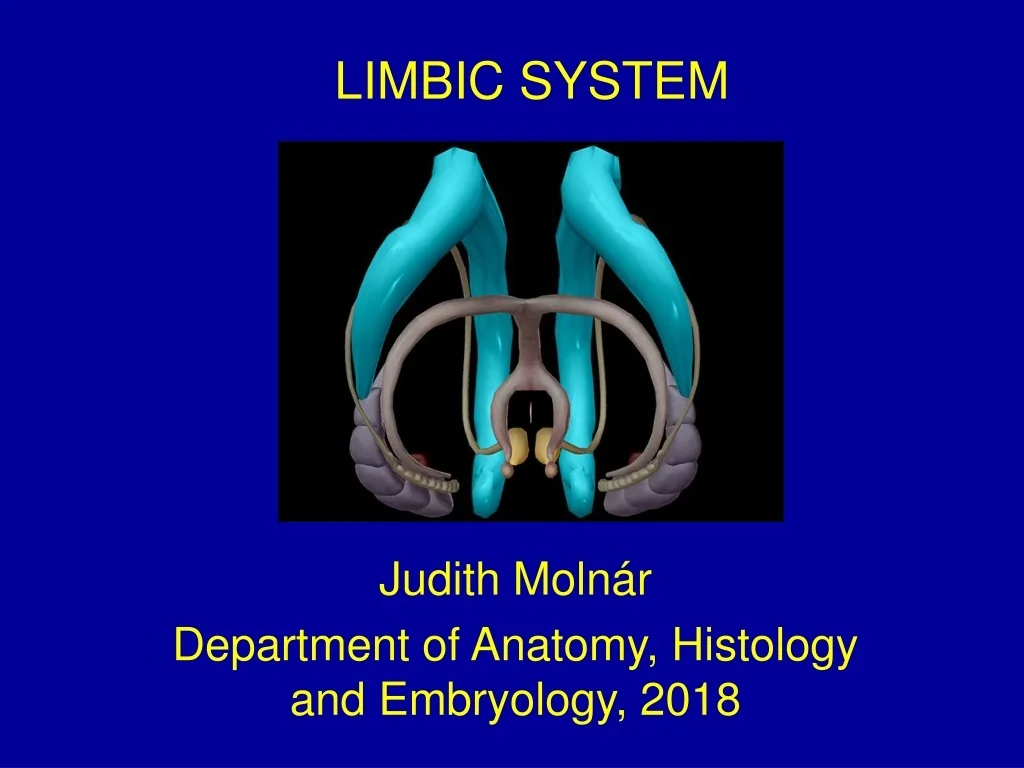
LIMBIC SYSTEM Judith Molnár Department of Anatomy, Histology and Embryology, 2018
The brain stem and basal ganglia are the parts of the brain what is called reptilian brain, and this is the most ancient part of the brain. Supervise the balance, territority, sexual behaviour, feeding, and other vital functions. • The midlle part is the limbic system, what inludes the septum, amygdala, hypothalamus, hippocampal complex, and the cingulate gyrus, is the mammalian brain, which direct emotions, memory and social behaviour. • The primate brain is the cerebral cortex. The human brain is the latest „product” of evolution, what makes possible the higher functions, like language, planning, abstraction etc.
The limbic system • The functions of the limbic system: storing, recalling memories, establishing the emotional state, linking the conscious, intellectual functions of the cortex with the unconscious and vegetative functions of the brainstem. • Cooperation between sensory, motor and association cortical areas makes it possible to perform tasks.The operation of the limbic system influences the will to perform the tasks
Pyramidal cells of hippocampus The dendrites are parallel to one another resulting in summation of extracellular current flow and hyper-excitability seen in epilepsy. The pyramidal dendrites are perpendicular to the cortical surface resulting in different layers of cortex impinging at different points along the dendritic tree. The pyramidal dendrites contain dendritic spines that amplify currents (inputs) so that distant synaptic sites can more easily generate action potentials. The pyramidal cells (dendrites) receive inputs from basket cells that regulate excitability of the pyramidal cells through recurrent inhibition.
Efferents of the entorhinal cortex • From the entorhinal cortex to hippocampus – two pathways • Perforants branches – dentate gyrus • Alvear branches – hippocampus
Hippocampus • The memories are not stored in the hippocampusban but the cognitive and sensory experiences are organized in long-term memory, stored in different brain regions. • Learning • Consolidation of memory • Long term memory
Hippocampus • Hippocampus mediates many cognitive functions – reciprocal connections with cortex • Allocentric and spatial learning and memory – cognitive map • Decision-making mechanisms – predicting future events helps to make decisions
Learning processes • When using spatial strategies, the hippocampus has greater activation. • In striatum, response strategies have greater activity. • There is a reverseratio of gray matter activity in striatum and hippocampus.
The pathways of the amygdala • Ventralis amygdalofugal pathway • Nucleus accumbens septi • Globus pallidus, ventral striatum • Nucleus olfactorius anterior • Gyrus cinguli anterior part • Septum • Hypothalamus • Stria terminalis • Septalis area • Hypothalamus • Habenula • Contralateral amygdala • Direct connections • Hippocampus • Entorhinal cortex • Thalamus, dorsomedial nucleus • Brain stem
Amygdala • Amygdala is an integration center: emotions, mediation between emotion-directed behavior and motivation. • It organizes appropriate emotional reactions triggered by information received from sensory organs. • Amygdala's efferentes to hypothalamus – visceral and somatic motor responses and prefrontal cortex – conscious emotional decisions.
Gyrus cinguli • The gyrus cinguli plays a role in expressing emotions – gestures
Connexion au compte
Connectez-vous pour publier votre contenu sur SlideServe.