Electron Configuration A Brief Look
40 likes | 167 Vues
This chapter explores the fundamental concepts of electron configuration, outlining how electrons are arranged around the nucleus in specific energy levels. Each energy level contains a number of sublevels corresponding to its level number, from 1 to 5, with each sublevel consisting of orbitals that can hold a maximum of two electrons. The outermost energy level, known as the valence level, can contain up to eight electrons across its orbitals, critical for understanding chemical bonding and reactivity in elements.


Electron Configuration A Brief Look
E N D
Presentation Transcript
Chemistry 112Chapter 5 Electron ConfigurationA Brief Look Mr. McIsaac Carleton North High School
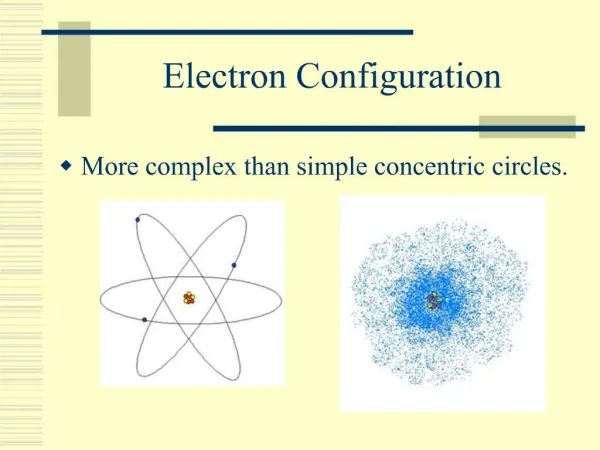
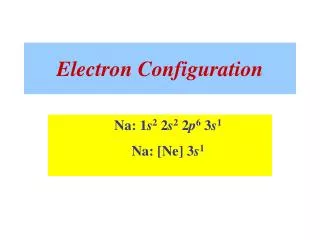
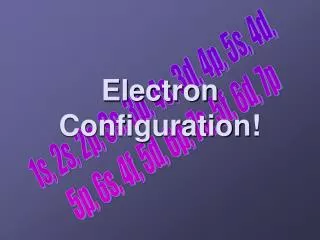
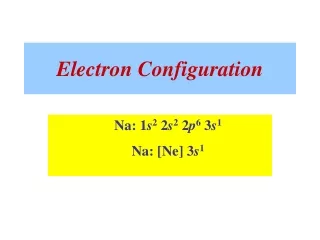
Electron Arrangement(Energy Levels, Sublevels, Orbitals) • Electrons travel around the nucleus at certain distances, called energy levels. • Inside each energy level, there are sublevels; the number of sublevels is equal the number of the energy level: • 1st energy level has 1 sublevel (s) • 2nd energy level has 2 sublevels (s, p) • 3rd energy level has 3 sublevels (s, p, d) • 4th energy level has 4 sublevels (s, p, d, f) • 5th energy level has 5 sublevels (s, p, d, f, g)
Electron Arrangement (cont.) • Inside each sublevel, there are orbitals –specific regions/areas inside the e cloud where individual e’s exist. • An orbital may be empty, or may hold 1 or 2 e’s. Any orbital can hold a maximum of 2 e’s. • An outer level (valence level) can hold a maximum of 8 e’s. So, an outer level has a maximum of 4 orbitals.
Electron Arrangement (cont.) • Stated another way, an outer level has a maximum of 2 sublevels (s, p). • An s sublevel has 1 orbital; a p sublevel has 3 orbitals. Total = 4 orbitals = 8 e’s (2 per orbital). • Valence electrons exist in these outer 4 orbitals.