Download
1 / 30
300 likes | 433 Vues
This document outlines key concepts and research priorities related to the Vertex Detector (VXD) for future linear colliders, focusing on achieving high luminosity and efficient flavour tagging. Tobias Haas emphasizes the need for optimized design parameters, including sensor technologies, resolution capabilities, and integration strategies. The document discusses the requirements for various physics processes, the importance of tagging efficiency, and innovations in sensor designs such as MAPS and CCD, as well as the challenges involved in detector construction.

E N D
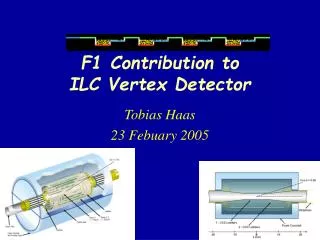
F1 Contribution to ILC Vertex Detector Tobias Haas 23 Febuary 2005
Linear Collider Basics • LEP gave ~ 1 fb-1 /expt. in 11 years, with 107 Z0 LEP1 • At √s = 500 GeV one needs 500 fb-1 to get: • ~ 30,000 Zh120 • ~ 50,000 h120νν • 106 W+ W- • At √s = 1000 GeV one needs 1000 fb-1 to get: • ~ 6,000 HA (300GeV) • ~ 3,000 h500νν • ~ 2,000 WWνν (if no Higgs) • Need lots of luminosity to scan multiple thresholds, vary polarisation, go to γγ, e-γ, e-e- Tobias Haas: Physics at a Future Linear Collider
Detector Considerations • Vertexing: • Flavour tagging with high purity and efficiency • Tracking: • Momentum resolution to measure recoil masses • Calorimetry: • Good segmentation and excellent EM energy resolution Tobias Haas: Physics at a Future Linear Collider
VXD for Heavy Flavour Identification • Flavour couplings of Higgs are basic to test SUSY scenarios: Many have different +2/3 vs. -1/3 couplings. b vs. c best hope. • 5 layers with 800 Mio pixels. Innermost layer at 1.5 cm • 0.03% X0/layer Tobias Haas: Physics at a Future Linear Collider
Visions of a VXD • 5 Layers • 20 x 20 m2 pixels • Sensor thickness < 60 m • 799 Mpixels • Readout time 50 s This is a major R&D project
Topics of VXD R&D • Sensor technology ← DESY • Efficiency, S/N, cost, ease of use, speed, radiation tolerance, environmental constraints • DAQ • Thinning ← DESY • Support, Cooling ← DESY • Detector design and integration ← DESY DESY/F1 activities started already in 2001
Some Example Activities • Topic 1: • Best possible VXD vs. What do we need to do the physics? • Topic 2: • Develop a sensor technology that does the job. • Topic 3: • How do we put sensors together to make a real detector? Tobias Haas: Physics at a Future Linear Collider
Some Example Activities • Topic 1: • Best possible VXD vs. What do we need to do the physics? • Topic 2: • Develop a sensor technology that does the job. • Topic 3: • How do we put sensors together to make a real detector? Tobias Haas: Physics at a Future Linear Collider
Introduction • Goal: • Optimization of design parameters for VXD: • Support, sensor thickness, overlaps, layer spacing… • Special considerations for specific technologies: MAPS, CCD, DEPFET • Placement of readout • Power, etc. • Steps • First • Explore many configurations quickly • Moderate Accuracy • Full physics capabilities • Second • Verify results with a high precision tool SGV MVD Meeting, 11/11/2003, Tobias Haas, DESY
Optimization Parameters • What should be the optimization parameters? • e.g. Tagging Efficiency… • … or effective error on some physics process? S. Xella-Hansen et al. LC-PHSM-2003-061 • ΔM ? MVD Meeting, 11/11/2003, Tobias Haas, DESY
Detector Optimization using a Complete “Toy” Analysis • Requirements: • Physics Generators • Fast Simulation (SGV) • Reconstruction/Analysis Suite • Tracking • EFOs • Jet Finders • Vertexing • Flavor Tagging • … More or less covered by SGV Not covered by SGV (ZVTOP) MVD Meeting, 11/11/2003, Tobias Haas, DESY
Contribution of V. Adler • V. Adler has latched b-tagging used in Brahms onto SGV • Not a completely trivial procedure: • Refit the resolution function to match the data set • A number of numerical issues (mostly evaluation of integrals) • Extend range of “Joint-Probability” tag to cover impact parameters significances up to 200 • Tune the definition of which tracks enter into the ZVTOP procedure • … get all coordinate transformations right! MVD Meeting, 11/11/2003, Tobias Haas, DESY
B-tagging • 4 algorithms classify jets: • Impact parameter joint probability tag • “tear down” vertex finder • “most significant” tracks in the jet • ZVTOP • NN gives three tagging outputs • B tag • C tag • B/C distinction tag MVD Meeting, 11/11/2003, Tobias Haas, DESY
Example ntuple thanks to Stefania Xella-Hansen MVD Meeting, 11/11/2003, Tobias Haas, DESY
Contribution of Pawel Łuzniak MVD Meeting, 11/11/2003, Tobias Haas, DESY
Finally: Use for Detector Optimization Studies: • Note: Result is compatible with results by T. Kuhl using SIMDET MVD Meeting, 11/11/2003, Tobias Haas, DESY
Some Example Activities • Topic 1: • Best possible VXD vs. What do we need to do the physics? • Topic 2: • Develop a sensor technology that does the job. • Topic 3: • How do we put sensors together to make a real detector? MVD Meeting, 11/11/2003, Tobias Haas, DESY
Sensor Technology Choices • MAPS (monolithic active pixel sensor) • Integrated R/O and sensor in CMOS • Piggy-back on commercial developments • Key Player: IRES Strasbourg • CCD • Long experience (SLD), large devices • Piggy-back on other scientific CCD development (Astronomy, synchrotron rad) • Key Player: RAL • DepFets • Thick active volume (Depletion voltage!) • Looks promising also for X-ray detection • expensive • Key Player: (MPI Munich) • SOI (Silicon on Insulator) • Great interest emerging recently • Key Player: Cracow MVD Meeting, 11/11/2003, Tobias Haas, DESY
Questions • Reproduce Strasbourg results • Investigate radiation tolerance and cross check with simulation • Study device properties in detail under various conditions • Operate in magnetic fields • Study power switching • Develop testbeam infrastructure (pixel telescope) • … MVD Meeting, 11/11/2003, Tobias Haas, DESY
Some Example Activities • Topic 1: • Best possible VXD vs. What do we need to do the physics? • Topic 2: • Develop a sensor technology that does the job. • Topic 3: • How do we put sensors together to make a real detector? MVD Meeting, 11/11/2003, Tobias Haas, DESY
Contributions by J. Hauschild, B. Löhr, C. Muhl MVD Meeting, 11/11/2003, Tobias Haas, DESY
Outlook and Activities • Physics Studies: • Work on the list of identified reference processes • Contribute to the overall software effort • Push the detector technology • Build a pixel telescope • Contribute to the chip design • Workout viable overall detector schemes: • Mounting/support cooling MVD Meeting, 11/11/2003, Tobias Haas, DESY