Download
1 / 10
100 likes | 217 Vues
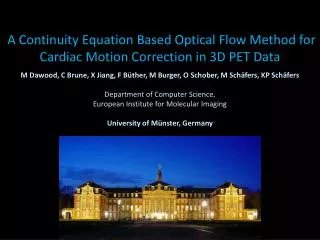
This study presents a novel optical flow method based on the continuity equation for correcting cardiac motion in 3D PET data. Conducted at the University of Münster, the approach addresses motion artifacts during systole and diastole using mass conservation principles. We demonstrate the method's effectiveness through visual results and quantitative analyses, including correlation with target phases, myocardial thickness measurements, and time-activity curves in the blood pool. This technique enhances the accuracy of cardiac imaging and improves diagnostic outcomes in PET scans.

E N D
A Continuity Equation Based Optical Flow Method for Cardiac Motion Correction in 3D PET Data M Dawood, C Brune, X Jiang, F Büther, M Burger, O Schober, M Schäfers, KP Schäfers Department of Computer Science, European Institute for Molecular Imaging University of Münster, Germany
Acquisition Times PET, Minutes CT, Seconds
Gating …
Mass conserved in cardiac data Systole FDG-PET 1 h.p.i. non-AC Diastole Continuity Equation:
Visual result Cardiacphases All gatesdeformedto Diastole