
SlideServe
Menu
Préférences
© SlideServe · v2026

Modal Choice

prema avatar
10 diapositives · 473 Views · Sep 19, 2014

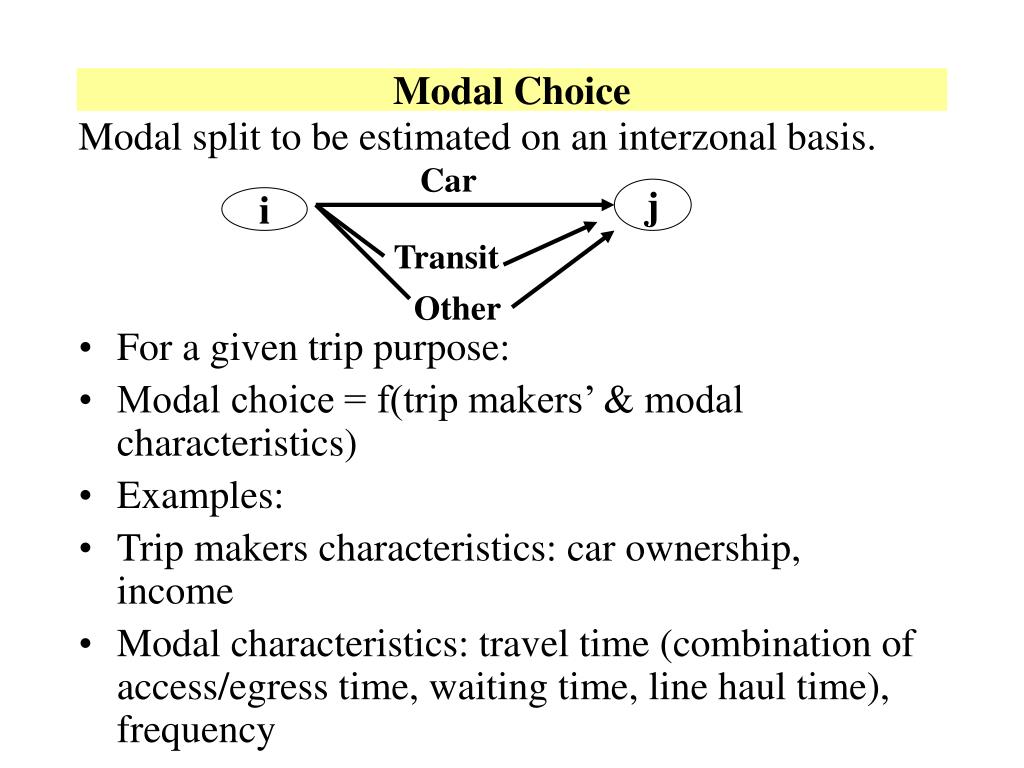
Modal Choice. Car. j. i. Modal split to be estimated on an interzonal basis. For a given trip purpose: Modal choice = f(trip makers’ & modal characteristics) Examples: Trip makers characteristics: car ownership, income
Modal Choice - slide 1
01 / 10Modal Choice
1 / 17

Télécharger la présentation

Modal Choice
Une image / un lien ci-dessous est fourni (tel quel) pour télécharger la présentation

Politique de téléchargement : le contenu du site vous est fourni TEL QUEL pour votre information et votre usage personnel ; il ne peut être vendu, concédé sous licence ni partagé sur d’autres sites sans l’accord de son auteur.Le contenu vous est fourni TEL QUEL, pour votre information et votre usage personnel uniquement. Téléchargez la présentation en cliquant sur ce lien. Lors du téléchargement, si vous ne parvenez pas à télécharger une présentation, l’éditeur a peut-être supprimé le fichier de son serveur.Pendant le téléchargement, si vous ne parvenez pas à obtenir une présentation, le fichier a peut-être été supprimé par l’éditeur.

F I N

Plus de contenu associé

Transcription de la présentation
  1. Modal Choice Car j i Modal split to be estimated on an interzonal basis. • For a given trip purpose: • Modal choice = f(trip makers’ & modal characteristics) • Examples: • Trip makers characteristics: car ownership, income • Modal characteristics: travel time (combination of access/egress time, waiting time, line haul time), frequency Transit Other

  2. Logit Model • Disaggregate level of analysis – the trip maker as the unit of analysis • Choice riders vs. Captives • Modelling travellers with a choice • Probability of selecting a mode is a function of the impedance (I) or generalized cost (disutility but called utility U) of modes. • U for a mode = f(travel time, travel cost, etc.) • Example: U(transit) & U(automobile) • From Probability of travellers’ mode choice, we • Infer % of travellers for each mode

  3. Logit Model (cont.) % auto captive % Transit 50% % transit captive 0 U(transit)-U(auto) -ve +ve

  4. Multinomial vs. Bimodal logit model Example of bimodal case: transit vs auto Pt = Probability that transit is chosen Pt Ut = Impedance of transit Ua = Impedance of auto e = base of log = 2.718 Pa= Probability that automobile is chosen Pt + Pa = 1.00 Logit Model (Continued) eUt = eUt + eUa

  5. Example: A calibration study has resulted in the following impedance (utility) equation for any mode m: Um = am – 0.025X(1) – 0.032X(2) – 0.015X(3) – 0.002X(4) am = constant X(1) = modal access + egress time (min) X(2) = waiting time (min) X(3) = line haul time (min) X(4) = out-of-pocket cost (cents) Logit Model (Continued) =

  6. From trip distribution model, for a future year Tij= 1000 person trips/day Future year service attributes: X(1) X(2) X(3) X(4) Auto 5 0 20 100 Bus 10 15 40 50 am modal constants: auto: -012, transit=-0.56 Find modal split. Solution: First compute U values U (auto) = -0.745 U(bus) = -1.990 Logit Model (Continued)

  7. Logit Model Example (Continued) Pauto = 0.78 Pbus = 0.22 1.00 Therefore modal shares from zone i to zone j: Auto users = 0.78x1000 = 780 trips Bus users = 0.22x 1000 = 220 trips 1000 trips

  8. Multinomial Logit Model Pm = eUm Σ for all m’(eUm) Where Pm = probability that mode m is chosen Um = utility of mode m (defined earlier) e = base of logarithms m’ = index over all modes included in the choice set Note: if only two modes are involved, the multinomial logit simplifies to the binary logit model.

  9. Multinomial Logit Model Example: A travel market segment consists of 900 individuals. A multinomial logit mode choice model is calibrated for this market segment, resulting in the following utility function: U = βm - 0.50C - 0.01T Where C = out of pocket cost (dollars), and T = travel time (minutes). βm values are Bus transit 0.00 Rail transit 0.20 Auto 2.40 For a particular origin-destination pair, the cost of an auto trip, which takes 12 minutes is $3.00. Rail transit trips, which take 20 minutes, cost $2.00. Bus transit takes 40 minutes and costs $1.25. Predict modal travel demand.

  10. Multinomial Logit Model Solution: Utility functions: U = βm - 0.50C - 0.01T U (automobile) = 2.40 - 0.50(3.00) - 0.01(12) = 0.78 U(rail) = -1.00 U(bus) = -1.025 Modal probabilities by using multinomial logit model: Pm = eUm/[Sum of eUm’] By using the above, we find P(auto) = 0.7501 P(rail) = 0.1265 P(bus) = 0.1234 Expected demand (auto) = 900(0.7501) = 675 for rail = 114 and for bus = 111. Total = 675+114+111 = 900 check.