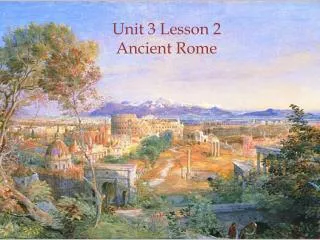
Unit 3 Lesson 2 Ancient Rome
460 likes | 600 Vues
This lesson provides an in-depth exploration of Ancient Rome's geography, early civilization, political structures, and cultural achievements. Situated on the Italian peninsula, with the Alps to the north and Apennine Mountains to the east, Rome's location facilitated trade and military expansion. It traces the transition from a republic to an empire, detailing key events like the Punic Wars, the rise of influential leaders such as Julius Caesar, and the social dynamics within Rome. The lesson highlights the significance of art, literature, and religion in shaping Roman culture.


Unit 3 Lesson 2 Ancient Rome
E N D
Presentation Transcript
Geography -Located on the Italian peninsula, in the center of the Mediterranean Sea -The Alps are in the North -The Apennine Mts. are on the eastern coast -broad, fertile plainsin the north and west
Rome Geography Rome is located: -On the banks of the Tiber River -On and around seven hills Why would this geographic location be an advantage?
Early Civilization -Italy was originally occupied by many different groups of people -Two main groups were Greek colonists and the Etruscans -The Etruscans ruled much of central Italy and Rome itself -Ancestors of the Romans, the Latins, settled in the area that is now Rome around 800 B.C.
Legend of the Founding of Rome 753 B.C. – Rome founded (according to legend) by Romulus and Remus, twin sons who were raised by a wolf. -According to the tale, the twins’ mother was a Latin woman and their father was the war god Mars
Politics 509 B.C. – Rome became a Republic. • Romans drove out their Etruscan ruler, Tarquin the Proud and swore to never have a king again.
Laws • 451 B.C. – Twelve Tables • Code of Laws; used the Ten Commandments as a basis • All citizens were equal before the law
Structure of the Republic • Patricians= landholding upper class • Plebeians= farmers, merchants, artisans, traders
Structure of the Republic • Senate= governing body; citizens elect leaders to vote • Consuls= two patricians • Dictator= assigned to be in charge in the event of a war • Voting rights were only extended to free-born males
Structure of the Republic • Plebeians have no say in the government • Eventually get to elect their own officials called tribunes in 494 B.C. • For 84 years, (421-337 B.C.) plebeians fought to have a role in each part of the government
Social Structures -Roman women were nearly social equals of men -Ran the household -Given authority and respect -Had personal freedom -Owned property -Could testify in court
Religion -Romans were polytheistic-they believed in many gods and goddesses -Many of the gods were adapted from the Greek gods • Roman calendar is full of feasts and celebrations to honor the gods and goddesses • Temples for worship to ask for divine assistance
Art, Architecture, and Literature -Borrowed many cultural influenced from the Classical Greeks – Greco-Roman culture developed -Frescoes were painted on walls -Literature followed Greek forms and models but addressed Roman themes
Art, Architecture, and Literature -Built spectacular works such as the Coliseum -Elaborate arches, domes, concrete
Art, Architecture, and Literature -Aqueducts were used to transport water to urban areas
Politics • Rome grows strong and begins conquering the rest of Italy • -By 270 B.C., Rome controls most of the Italian peninsula • Military is made up of citizens • Rome conquered justly- allowing those conquered to keep their culture, customs, and government- as long as they supplied soldiers, paid taxes, and acknowledge Roman leadership
The Punic Wars -Series of wars fought between Rome and Carthage (N. Africa) -Rome fought Carthage in three wars from 264 B.C. to 146 B.C. (118 years)
The Punic Wars 264 B.C. – 1st Punic War Begins. Rome won control of Sicily.
The Punic Wars 218 B.C. – 2nd Punic War Begins. Hannibal invaded northern Italy.
The Punic Wars 202 B.C. - Hannibal was defeated at Zama by Scipio
The Punic Wars 146 B.C. - 3rd Punic War Begins. Rome destroyed Carthage and made Carthaginians their slaves.
Republic to Empire 133 & 121 B.C. - The Gracchus Brothers were murdered -They had worked to help the poor, but the Senate had them killed. -Their murders resulted in civil wars.
Republic to Empire -Civil warsbreak out to decide who should hold power. The senate wanted to keep the status quo; political leaders wanted to weaken the senate and enact reforms -Slave uprisings throughout the republic -Armies became loyal to their commandersbecause they gave them benefits such as captured land
Turmoil in Rome 88 B.C. – Sulla marched on Rome and became Dictator
Turmoil in Rome 60 B.C. – Triumvirate formed between Julius Caesar, Crassus, and Pompey (3 generals) -Cicero worked during this time to recreate the values of the Republic 58-54 B.C. - Caesar conquered Gaul and Britain. 49 B.C. - Caesar invaded Rome and defeated Pompey. 47 B.C. - Caesar invaded Egypt and appointed Cleopatra queen.
Turmoil in Rome 46 B.C. – appointed Dictator by the Senate. 44 B.C. – named Dictator for life, later assassinated by Senate. Marc Antony got control of Rome
Turmoil in Rome 43 B.C. – Second Triumvirate formed between Marc Antony, Octavian (Caesar’s nephew), and Marcus Lepidus. 31 B.C. – Battle of Actium, Octavian defeats Marc Antony and Cleopatra.
Roman Empire 27 B.C. – Octavian declared “Augustus Caesar” Beginning of the Roman Empire -Conquered territory -Single sovereign authority -Controlled militarily Pax Romana began – brought peace, built public buildings, created a lasting government, and set up civil service, allowed Christianity to spread
Roman Empire 27 B.C. to A.D. 68 – Julian-Claudian Dynasty – AugustusCaesar, Tiberius, Caligula, Claudius, Nero
Roman Empire 5/4 B.C. – Birth of Christ in Judea. AD. 28 – John the Baptist executed. AD. 30 – Jesus crucified - Roman leaders feared he would incite people with claims he was the Messiah. -Peter and Paul continued to spread Christianity.
Roman Empire A.D. 64 – Fire destroys Rome; Nero orders persecution of Christians.
Roman Empire A.D. 122 – Construction of Hadrian’s Wall begins.
Roman Empire c. A.D. 250 – Decline of Rome -Bread & Circuses – rulers attempted to keep the people happy by providing food and entertainment (gladiators)
Roman Empire Causes -Disruption of Trade -Inflation, higher taxes -Food shortages due to overworked soil and civilwars. -Invading Barbarians -Lack of trustworthy generals -Empire had expanded too rapidly
Roman Empire • A.D. 285 – Emperor Diocletian was unable to defend the Empire from Germanic invaders. • -Divided Empire in half. • -Diocletian ruled the East. • -Co-emperor Maximian ruled the West • -Diocletian tried to fix the economy and declared himself a son of a Roman god.
Roman Empire A.D. 313 – Roman Emperor Constantine said Christians would not be persecuted; later made Christianity the official religion AD. 324 – Constantine became Emperor of both halves of Empire. Constantine moved the capital to Byzantium and renamed it Constantinople AD. 407 – Rome leaves Britain.
Roman Empire A.D. 410 – Visigoths under Alaric sack Rome AD. 444 – Huns unite under Attila and terrorize all of the Roman Empire.
Roman Empire AD. 476 – Germanic people control much of Europe. Removed last western Roman Emperor from the throne. -The Byzantine Empire in the east continued
Roman Empire A.D. 529 – Justinian Code -Byzantine law code -Foundation for western legal tradition