Understanding Z-Scores: Calculating and Comparing Standardized Scores
100 likes | 229 Vues
This module explores the concept of Z-scores, which convert raw scores into standard deviation units, enabling effective comparison of individual performance across different tests. Z-scores indicate a score's position within a distribution, signifying how it stands relative to others. By understanding how to calculate Z-scores and their benefits, such as determining proportional standings and comparing scores with different means and standard deviations, learners can grasp the implications of their performance on standardized assessments and make informed evaluations.


Understanding Z-Scores: Calculating and Comparing Standardized Scores
E N D
Presentation Transcript
Module 8 z Scores • What they are • Benefits • Calculating them • Comparing them
Standard Scores • Standard scores are scores expressed in a standardized unit of measurement • Standard scores indicate the position of a score relative to the distribution (for central Tend & dispersion)
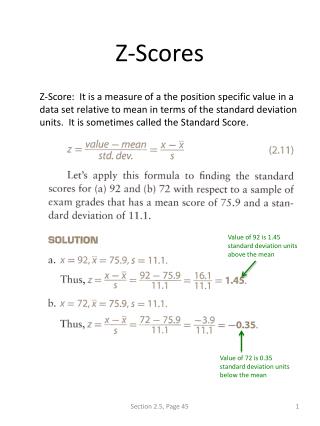
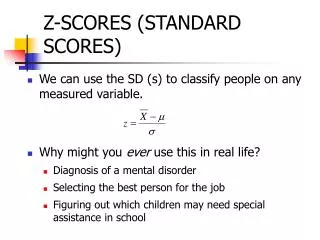
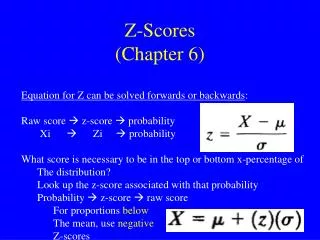
Z-ScoresMemorize this formula • Z-scores are raw scores converted to standard deviation units • Formula for z-score
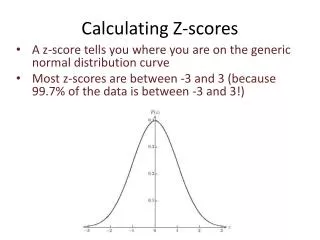
Benefits: • Z-scores can be used to determine proportions of the curve
Benefits • To compare (relative to others) how a person did on two tests • with different Ms and SDs • With different number if items • (can’t do that with raw scores)
To compare relative to others • Need to know… • More than the raw score • More than the % correct • More than his/her relative standing • Also need to know… • How spread out the scores around his/her are • i.e. score distribution (SD) • Where the score falls within the spread
z score calculation • X = any given score • M = Mean • s = Sd of the test or measure • The distance from the M is rescaled into SD units
z Scores • If the z score is above the mean…it’s positive • (+ SDs) • Raw score is above the mean • If the z Score is below the mean…it’s negative • (- SDs) • Raw score is below the mean • Check to make sure you don’t make a calculation error
Comparison of scores relative to others on same test • IQ of 120 z of + 1.33 (above the mean) …means that is 90.82 % of scores(.9082) are at or below a raw score of 120 If 90.82 % have IQs below 120 Then 90.82% - 50% = 40.82% …have IQ scores between the Mean (100 and 120)
Comparison Across Different Tests • Because the z score accounts for • Central tendency (Mean) • Dispersion (s) • Sample size (N) • M = ∑X/N • And has the same M of 0 and SD of 1 • We can compare someone’s scores • On different tests with which have a • Different M, s, or N