Download
1 / 29
290 likes | 438 Vues
This agenda outlines the Language Arts activities for the week of September 4-7, 2012. Students will retrieve their notebooks, complete warm-up writing prompts, and work on their HIPSOMA poems, due by Friday, September 7. Daily prompts encourage creativity and personal reflection, exploring figurative language such as similes and personification. Emphasis is also placed on distinguishing between simple and compound sentences. Bring a portable jump drive with poem drafts to enhance collaboration and resource sharing.

E N D
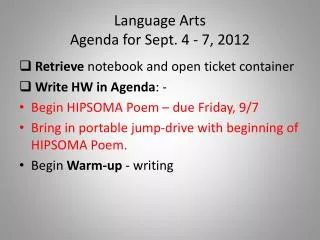
Language Arts Agenda for Sept. 4 - 7, 2012 • Retrieve notebook and open ticket container • Write HW in Agenda: - • Begin HIPSOMA Poem – due Friday, 9/7 • Bring in portable jump-drivewith beginning of HIPSOMA Poem. • Begin Warm-up - writing
Language Arts Agenda for Sept. 4, 2012 • Retrievenotebook and open ticket container. • Write HW in Agenda: - • Begin HIPSOMA Poem – due Friday, 9/7 • Bring in jump-drive with start of HIPSOMA Poem on it. • Begin Writing Warm-up Date: 9-4-12 Prompt: If you could be a book character, who would you be and why? (5 sentence response)
Language Arts Agenda for Sept. 5, 2012 • Retrieve notebook, Netbook & open ticket container. • Write HW in Agenda: - • Add to HIPSOMA Poem – due Friday, 9/7. • Bring in jump-drive with partial HIPSOMA Poem on it. • Begin Writing Warm-up Date: 9-5-12 Prompt: Think about the many things that have wheels. How would the world be different if the wheel had never been invented? (5 sentence response) • Log on.
Language Arts Agenda for Sept. 6, 2012 • Retrievenotebook, Netbook and open ticket container. • Write HW in Agenda: - • Add to HIPSOMA Poem – due Friday, 9/7. • Bring in jump-drive with partial HIPSOMA Poem on it. • Begin Writing Warm-up Prompt: In 1620 the Pilgrims boarded the Mayflower and sailed away to England to settle a new land. As you start the new school year, what do you leave behind from last year? What do you look forward to? (5 sentence response) • Log-in.
Language Arts Agenda for Sept. 7, 2012 • Retrieve notebook and open ticket container. • Write HW in Agenda: - • Add to HIPSOMA Poem – due Friday, 9/7. • Bring in jump-drive with partial HIPSOMA Poem on it. • Begin Writing Warm-up Prompt: Do you have a special place at home to do your homework? If so, what is the place like? Describe a good work place. If you don’t have a work place at home, ask your parents if you can prepare one this week. (5 sentence response)
Language Arts Sept. 4, 2012 • View Figurative Language PPT (HIPSOMA) • Go over model of HIPSOMA Poem • Begin work on HIPSOMA Poem
Figurative Language Resource • Hyperbole: An obvious exaggeration. Sometimes it is confused with a simile or metaphor. (Example: Mrs. Jones gives tons of homework.) • Idiom: a phrase or expression that means something different from what the words actually say. (Example: It is raining cats and dogs.) • Personification: Giving human qualities to an animal, object, or idea. (Example: The pencil danced across the [paper.) • Simile: Compares two things that are unlike but have some qualities in common. It does use the words like or as. (My nose is red like a cherry. My nose is as red as a cherry.) • Onomatopoeia: The use of words whose sounds echo their meaning. (Example: The bee went buzz.) • Metaphor: Compares two things that are unlike but have the same qualities in common. It doesnot use the words like or as. (Example: The tree is a ballerina in green.) • Alliteration: The repetition of consonant sounds at the beginning of word. (Example: The wild woolly walrus waits and wonders when we’ll walk by.)
Language Arts Sept. 5, 2012 • Smart Board – review of simple and compound sentences • Students continue work on computers (HIPSOMA Poems). Remember to use resource sheet from notebook.
Simple vs. Compound Sentences • What is the difference?
Simple Sentences • A simple sentence contains a ________________ and a _______________. • It can stand all by itself. It is independent which means it does not have to depend on anything else. Therefore we call it an • _________________________________ clauses.
Compound Sentences A compound sentence is made up of two _________________________________ clauses.
Compound Sentences There are two types of compound sentences. One contains a ___________________________ conjunction that separates the independent clauses. We remember these conjunctions by calling them _________________________________.
Compound Sentences We remember the coordinating conjunctions by calling them FANBOYS. F = ___________________________________ A= ___________________________________ N= ___________________________________ B= ___________________________________ O= ___________________________________ Y= ___________________________________ S= ___________________________________
Compound Sentences When we use a coordinating conjunction (FANBOYS) in a compound sentence, we place a __________________________ in front of it. , FANBOYS
Compound Sentences • Another way to represent a compound sentence is to use a __________________________________ between the two independent sentences. ;
Practice: Simple vs. Compound Sentences Practice worksheet. Finish for HW.
Elements of Poetry Stanza = a group of lines, usually similar in length and pattern. Many stanzas in poems are divided by a _________________________. They look very much like a ________________________________ in a book. Each stanza usually talks about one ___________________.
Elements of Poetry Verse = a single _______________________ of a poem. It may be a complete __________________________, but must of the time it is a sentence ___________________________.
Elements of Poetry “Lighting a Fire” by X. J. Kennedy One quick scratch of a kitchen match And giant flames unzip! How do they store So huge a roar In such a tiny tip?
Elements of Poetry How many stanzas? _________________ How many verses?__________________ The three lines (verses) in each stanza make up a single __________________________. And each stanza contains its own main _____________________.
Elements of Poetry • RHYME = a repetition of ____________________________________ at the end of words. (i.e. bleak and streak rhyme).
Elements of Poetry RHYTHM = sound pattern created by stressed and unstressed syllables. Stressed syllables receive more emphasis than unstressed syllables. i.e. “The morns are meeker than they were,”
I AM Poem I AM (my 1st stanza) • I AM caring and understanding. • I WONDER what the homeless people do. • I HEAR sleigh bells ringing. • I SEE a snowman dancing. • I WANT peace on our Earth. • I AM caring and understanding.
I AM Poem I AM (my 2nd stanza) • I PRETEND to be a robot walking around. • I FEEL like a bird that is flying. • I can TOUCH the moon. • I WORRY about my nieces and nephews. • I CRY about the unfairness in the world. • I AM caring and understanding.
I AM Poem I AM (my 3rd stanza) • I PRETEND to be a robot walking around. • I FEEL like a bird that is flying. • I can TOUCH the moon. • I WORRY about my nieces and nephews. • I CRY about the unfairness in the world. • I AM caring and understanding.
I AM Poem I AM (my 4th stanza) • I UNDERSTAND how other people feel. • I SAY be nice to each other. • I DREAM about children laughing. • I TRY to be fair to other people. • I HOPE others will find happiness. • I AM caring and understanding