Understanding Binary Ionic Compounds and Empirical Formulas
This guide explores the concepts of binary ionic compounds and empirical formulas, emphasizing the importance of correctly identifying the simplest whole-number ratio of elements in ionic compounds. It highlights examples of empirical formulas, distinguishes ionic from molecular formulas, and explains how to write binary ionic formulas using the criss-cross method to ensure charge neutrality. Key terms such as oxidation states and the characteristics of monatomic ions are also discussed to aid in mastering the formation of ionic compounds.

Understanding Binary Ionic Compounds and Empirical Formulas
E N D
Presentation Transcript
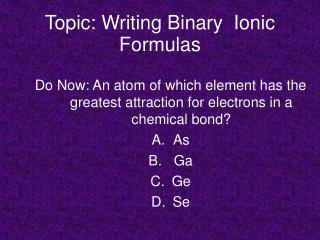
Do Now: An atom of which element has the greatest attraction for electrons in a chemical bond? As Ga Ge Se Topic: Writing Binary Ionic Formulas
Empirical Formulas = smallest whole-number ratio of elements in compound • Ionic compounds have empirical formulas only
Identify the empirical formulas • H2O • H2O2 • CaF2 • NaCl • CH4 • C2H6 • NiO • FeCl3 Empirical – NOT ionic Molecular – NOT ionic Empirical, Ionic Empirical, Ionic Empirical – NOT ionic Molecular – NOT ionic Empirical, Ionic Empirical, Ionic
Formula Unit = simplest ratio of ions in ionic compound Examples: • KBr is formula unit • potassium ions & bromide ions are in a 1-to-1 ratio • Al(NO3)3 is formula unit • Aluminum & nitrate ions in 1-to-3 ration
Binary Ionic Compounds • Composed of two different elements • Positive monatomic metal ion • Negative monatomic nonmetal ion Note: A binary compound may contain more than 2ionsbut only 2kindsof ions like Al2O3
Na+1 Ca+2 O-2 Fe+2 and Fe+3 Al+3 and Ag+1 Oxidation Number or State • charge of monatomic ion • has right superscript • Some elements form only 1 ion • Some elements can form more than 1 ion
Oxidation States • Group 1 ions always +1 • Group 2 ions always +2 • MOST group 13 ions are +3 • Groups 14, 15, 16, and 17 have multiple oxidation states • both (+) and (-) • Transition metals (Group B) can have more than 1 oxidation state • but are always (+)
Writing Formulas for Binary Ionic Compounds • first rule in writing formulas for ionic compounds is POSITIVE ION FIRST But how do you get the subscripts? start by writing formulas from the ions
Compounds are electrically neutral • Sum of all charges in compound should be 0 • (+) and (-) charges must = each other
Equal but Opposite Charges • Na+1 and Cl-1: NaCl +1 + (-1) = 0 • Mg+2 and O-2: MgO +2 + (-2) = 0 • Al+3 and P-3: AlP +3 + (-3) = 0 • Rule: write symbols, (+) FIRST!
Try a few formulas: • Li+1 and I-1 • Ca+2 and O-2 • Al+3 and N-3 • K+1 and F-1 • Ba+2 and S-2 LiI CaO AlN KF BaS
Criss-Cross Method • When the charges don’t cancel out immediately: • Mg+2 and Cl-1, CROSS and DROP! (# only, forget signs!) • Mg1Cl2 but if subscript is 1, forget it! • MgCl2 means 1 Mg+2 and 2 Cl-1
Check the Math • MgCl2 means 1 Mg+2 and 2 Cl-1 (1 x +2) + (2 x -1) = +2 + -2 = 0 • charges MUST add up to zero!
Try a few formulas: CaCl2 • Ca+2 + Cl-1 • Na+1 + O-2 • Cs+1 + S-2 • Al+3 + Cl-1 • Al+3 + Se-2 • Mg+2 + F-1 • K+1 + N-3 Na2O Cs2S AlCl3 Al2Se3 MgF2 K3N
Of course, it gets more difficult KF • Potassium (K) and Fluorine (F) • Zinc (Zn) and Iodine (I) • Sodium (Na) and Oxygen (O) • Magnesium (Mg) and Oxygen (O) • Aluminum (Al) and Oxygen (O) • Calcium (Ca) and Bromine (Br) • Cesium (Cs) and Iodine (I) • Silver (Ag) and Sulfur (S) ZnI2 Na2O MgO Al2O3 CaBr2 CsI Ag2S