
Eating Disorders
E N D
Presentation Transcript
Eating Disorders Zaid B. Malik, MD University Of Arkansas for Medical Sciences.
Overview • Types • Diagnostic Criteria • Etiology • Complications • Rx
DSM-IV-TR Eating Disorder • Anorexia Nervosa • Bulimia Nervosa • Binge- eating Disorder ( classified as Eating Disorder NOS)
Basic Concept of ED • Disordered pattern of eating, accompanied bydistress, disparagement, preoccupation and / or distortion associated with one’s eating, weight or body shape.
Etiology • Multi factorial, with both genetic and environmental contributing risk factors. • Genetic , Biological ( Serotonin, Nor epinephrine, dopamine, hypothalamic dysfunction, and thyroid dysfunction. • Social ( dysfunctional family system as whole, can involve sexual abuse hx.
Western society promote a drive for thinness, participation in sports that emphasize weight restriction
Individual use of obsessive eating behavior as a replacement for normal adolescent pursuits of social and sexual functioning. • Individual feeling under excessive control of their parents.
Individuals are unable to interpret body hunger signal because of early experience of inappropriate feeding.
Course….. • 50 % of individuals with Anorexia and Bulimia nervosa make a full recovery where as 30% partially recover and 20 % follow a chronic course. • * Individuals with BED have a slightly favorable outcome. • * Mortality rate with AN is 0.6 % annually.
Epidemiology • Which one is more prevalent?? AN or BN or BED
EPIDEMIOLOGY….. • PREVELENCE: AN is the least prevalent ED, affecting aprox. 0.3 % young adult females. BN affect aprox. 1 % of young adult females and BED affect aprox. 2.6 % of young adults.
Demographics • Which gender is more likely to have which ED…
DEMOGRAPHICS • Typically affect young adult females with 85 to 95 % of cases of AN and BN and approximately 60 % of cases of BED occurring among females.
Onset • What start early, AN / BN / BED
ONSET • AN is slightly earlier than BN, both generally begin in adolescence, however both can occur at much older age. • Onset of BED tends to be slightly later, generally beginning in late adolescent or early twenties.
Mean age of onset for AN is 17 with a bimodal peak at ages, 12 and 18, onset after 40 is un common.
SOCIOCULTURAL FACTORS. • Reported all over the globe, but more prevalent in industrialized and or/ Westernized societies. Several epidemiologic studies have linked immigration, modernization and urbanization to risk.
DIAGNOSTIC FEATURES OF AN • Refusal to maintain a body weight at or above a minimally normal weight for age and height.( Below 80th %tile) • Intense fear of gaining weight or becoming fat, even though underweight. • Disturbance in a way in which one’s body weight or shape is experienced.
In postmenarcheal females, amenorrhea ( i.e absence of at least three consecutive menstrual cycles)
YOU HAVE TO HAVE ALL OF THESE TO DIAGNOSE ANOREXIA NERVOSA OR THE DIAGNOSIS IS…..
SUBTYPES • RESTRICTING TYPE: Person not regularly engaged in binge- eating or purging behavior) • BINGE-EATING/ PURGING TYPE: Person has regularly engaged in binge eating or purging behavior.
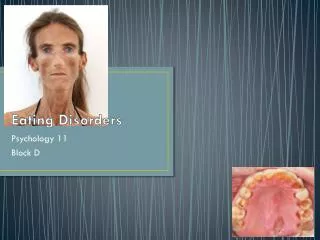
** Individuals typically have a normal appetite until the illness progresses to dangerous level of emaciation. Food restriction represents a drug of choice. Self worth often become tied to the ability to achieve and maintain an emaciated state.
Alternating b/w the restricting and binge eating type is possible.
Physical and Lab findings • What do you expect, from head to toe and lab work up??
PHYSICAL AND LAB FINDINGS • VITAL SIGNS: Bradycardia, hypotension, hypothermia. • CVS: QTc widening, CHF, Edema, Dehydration, Orthostasis, Impaired perephral circulation. • GI : Impaired motility, Elevated LFT’s, Elevated serum amylase, Erosion of tooth, Mallory Weiss Syndrome.
Hematological : Pancytopenia, leukopenia, anemia) • Renal: Calculi, Elevated BUN • Endocrine: Decreased T 3 and T 4, Decreased Estrogen in females and Testosterone in males. • Musculoskeletal : Osteoporosis, wasting.
Dermatological: Dry yellow skin, lanugo hair, hair loss, calluses on dorsum of hand ( Russell Sign). • Nutritional Changes: Electrolyte disturbances, parotid gland enlargement. ( Chickmuck face )
WORKUP • Complete physical and psychiatric exam. • Lab studies • Psychological Testing ( MMPI, Eating Attitudes Test, Eating Disorder Inventory )
Co morbidity • Which diagnostic spectrum do you think will be most common with AN??
COMORBIDITY • BN ( variable ) • Substance Use ( 26%) • MDD ( 50- 75 %) • Anxiety ( 50- 75 %) • Personality D/O ( up to 50 % )
TREATMENT • GOALS: Restore and maintain at least a minimal adequate body weight, reduce complicating factors, improve the willingness to correct the anorexia through therapy.
Consider HOSPITALIZATION, if weight below 20 to 30 % normal, sever medical complications. • No medications are FDA approved. Prozac, Thorazine, Zyprexa, Periactin, ReVia, ECT may be helpful.