John Dewey
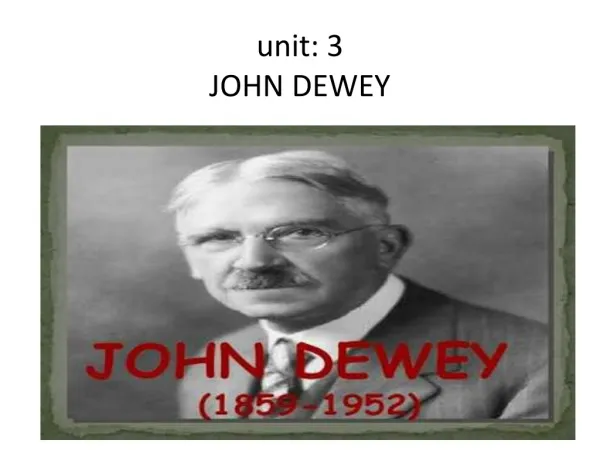
John Dewey. Father of Progressive Education. Background on Dewey. 1859-1952 Born in Burlington, Vermont Went to the University of Vermont and graduated Phi Beta Kappa in 1879 Received Ph.D from Johns Hopkins University Married twice with six kids
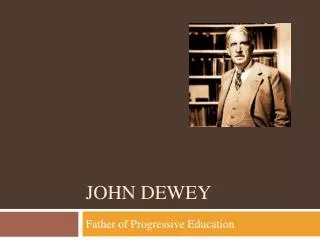

John Dewey
E N D
Presentation Transcript
John Dewey Father of Progressive Education
Background on Dewey • 1859-1952 Born in Burlington, Vermont • Went to the University of Vermont and graduated Phi Beta Kappa in 1879 • Received Ph.D from Johns Hopkins University • Married twice with six kids • Major books: “Democracy and Education” (1916), An introduction to the philosophy of education. • “How We Think” (1933), A restatement of the relation of reflective thinking to the educative process • “Experience and Education” (1938), Outline a philosophy of experience and its relation to education
Theories of Progressivism • Believes that education should be “democratic” • Active participation for all citizens in social, political and economic decisions • Respect for diversity • Development of critical, social and engaged intelligence • Allows citizens to understand policies and participate within a community
Pedagogy of Dewey • “I believe that the only true education comes through the stimulation of the child's powers by the demands of the social situations in which he finds himself.” • “I believe that this educational process has two sides - one psychological and one sociological; and that neither can be subordinated to the other or neglected without evil results following.” • “Psychological understanding of the child must be the basis of education; without it the educative process will fail.” -John Dewey, My Pedagogic Creed
Application of Dewey in the Classroom • Can be applied by: • Encouraging group interaction and cooperative learning • Engendering a sense of democracy by giving the students equal opportunities • Allowing the students the opportunity to control some of the material • Designing lessons to promote diversity
Encouraging group interaction and cooperative learning • “Active participation of citizens” can be applied by: • Engaging students in hands-on activities • Assigning students into random groups • Making the students responsible for group projects
Engendering a sense of democracy by giving the students equal opportunities • “Allowing citizens to understand policies and participate within a community” can by applied by: • Making sure all voices are heard, not just those that know-it-all. • Make the room safe for every student to have an opinion.
Allowing the students the opportunity to control some of the material • “Development of critical, social and engaged intelligence” can be applied by: • Give the students choices as to what they can study. • “The fallacy consists in supporting that we can begin with ready-made subject matter of arithmetic, or geography or whatever, irrespective of some direct personal experience of the situation.” –John Dewey, Democracy and Education
Designing lessons to promote diversity • “Respect of Diversity” can be applied by: • Designing lessons that encourage thinking beyond your community • Helping to advance student self-efficacy • Recognize the multitudes of abilities and interests in the classroom
An Example: The Group Project • Have a class form random groups • Assign a broad topic: people/place/time • The group themselves will decide what it is they will research by vote • The group assigns roles to group members • The groups must create something that is representative of their democratically chosen topic
Citations • http://www.uvm.edu/~dewey/articles/proged.html • http://www.slideshare.net/CPappasOnline/educational-progressivism • http://wilderdom.com/experiential/JohnDeweyPhilosophyEducation.html#Resources • http://www.notablebiographies.com/De-Du/Dewey-John.html • http://www.infed.org/thinkers/et-dewey.htm • Dewey, John. Democracy and Education, New York, NY; The Free Press, 1916