SlideServe
Menu
Préférences
© SlideServe · v2026

common characteristics internal skeleton of cartilage or bone

quennell-poirier avatar
23 diapositives · 437 Views · Nov 27, 2014

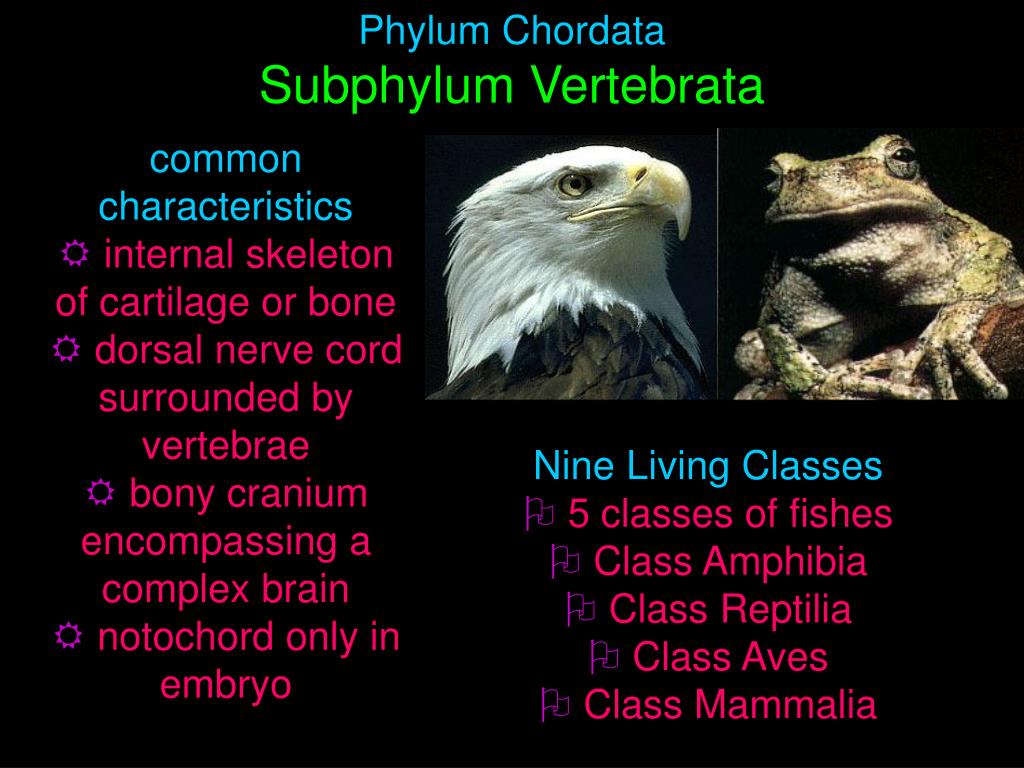
Phylum Chordata Subphylum Vertebrata. common characteristics internal skeleton of cartilage or bone dorsal nerve cord surrounded by vertebrae bony cranium encompassing a complex brain notochord only in embryo. Nine Living Classes 5 classes of fishes Class Amphibia Class Reptilia
common characteristics internal skeleton of cartilage or bone - slide 1
01 / 23common characteristics internal skeleton of cartilage or bone
1 / 17

Télécharger la présentation

common characteristics internal skeleton of cartilage or bone
Une image / un lien ci-dessous est fourni (tel quel) pour télécharger la présentation

Politique de téléchargement : le contenu du site vous est fourni TEL QUEL pour votre information et votre usage personnel ; il ne peut être vendu, concédé sous licence ni partagé sur d’autres sites sans l’accord de son auteur.Le contenu vous est fourni TEL QUEL, pour votre information et votre usage personnel uniquement. Téléchargez la présentation en cliquant sur ce lien. Lors du téléchargement, si vous ne parvenez pas à télécharger une présentation, l’éditeur a peut-être supprimé le fichier de son serveur.Pendant le téléchargement, si vous ne parvenez pas à obtenir une présentation, le fichier a peut-être été supprimé par l’éditeur.

F I N

Plus de contenu associé

Transcription de la présentation
  1. Phylum Chordata Subphylum Vertebrata common characteristics • internal skeleton of cartilage or bone • dorsal nerve cord surrounded by vertebrae • bony cranium encompassing a complex brain • notochord only in embryo Nine Living Classes • 5 classes of fishes • Class Amphibia • Class Reptilia • Class Aves • Class Mammalia

  2. The Fishes Pikaia: first fossil vertebrate (580 m.y.a.) Superclass Agnatha Fishes Without Jaws Class Myxini Hagfishes Class Petromyzontida Lampreys

  3. Fishes Without Jaws Body eel-like, no paired appendages Fibrous, cartilaginous skeleton (no vertebrae) Heart with one atrium, one ventricle External fertilization Gonads of both sexes in each individual (but only one sex functional)

  4. Class Myxini hagfish • marine • scavengers • partial cranium • great sense of smell • no sense of sight

  5. Feeding rasping tongue and sliding knot

  6. Class Petromyzontida lampreys • free-swimming parasites/predators • sucker-like mouth • reproduce in streams, migrate to sea (or lakes)

  7. Fish Parasites

  8. Eggs in gravel nest in stream riffle Adult lamprey attached to host fish Larvae drift downstream to muddy backwater Metamorphosis and migration to lake or sea Worm-like larvae in mud 5+ years

  9. The Fishes Superclass Gnathostomata Fishes With Jaws Class Chondrichthyes Cartilaginous Fishes Class Actinopterygii Ray-finned Fishes Class Sarcopterygii Lobe-finned Fishes

  10. Evolution of the Jaws Modification of existing structures to perform new functions

  11. Vertebrates with Jaws Superclass Gnathostomata strong jaws armored with heavy plates paired pectoral & pelvic fins First Jawed Fish = Placoderms

  12. Further modifications for more efficient function

  13. Cartilaginous Fishes Class Chondrichthyes Skates, Rays, and Sharks • 5 to 7 gill slits • no gill covers • placoid (toothlike) scales • filter feeders or predators

  14. Bony Fishes (The Osteichthyes) Class Sarcopterygii (lobe-finned fishes) Class Actinopterygii (ray-finned fishes) • operculum over gill slits • bony skeleton • dermal scales • swim bladder

  15. Fish Circulatory System

  16. Fish Respiration Counter Current Circulation Same Direction Flow Countercurrent Flow

  17. Swim Bladder

  18. Anadromous Reproduction

  19. Class Actinopterygii Ray-finned Fishes • radiating supports in fins • filter feeders or predators • dermal scales (formed of bone)

  20. Evolution of The Tetrapods Two Hypotheses • Lobe-finned fishes capable of moving from pond to pond • Abundant food (and absence of predators) on land

  21. Class Sarcopterygii Lobe-finned Fishes • strong, fleshy fins • fins supported by central (not radiating) bones • heavy, enameled scales