Enhancing OLAP Performance with XML Federations: Query Optimization Techniques
This paper, presented at the DOLAP 2002 Workshop, explores optimizing query processing within OLAP systems using XML federations. It discusses the challenges of integrating dynamic and diverse data sources in XML format, emphasizing inlining, caching, and prefetching techniques for efficient retrieval. The authors present experimental results showcasing improvements in OLAP query performance through a federation system that enables flexible access to XML data as virtual dimensions. Future work directions aim at refining these methods for superior adaptability and efficiency in data analysis.

Enhancing OLAP Performance with XML Federations: Query Optimization Techniques
E N D
Presentation Transcript
Query Optimization For OLAP-XML Federations Dennis Pedersen Karsten Riiis Torben Bach Pedersen • Nykredit Center for Database Research • Department of Computer Science, Aalborg University • www.cs.auc.dk/NDB
Overview • Motivation • OLAP-XML federations • Federation system • Inlining • Optimizing XML retrieval • Caching and prefetching • Experimental results • Related work • Conclusion and future work DOLAP 2002 Workshop
Motivation • OLAP-systems are good for complex analysis queries • Easy-to-use • Fast • Business, science ... • More and more data is needed for the analyses • Problems with physical integration in existing OLAP systems • Integrating new data requires (partial) cube rebuild => too slow • Problems arise with • Short term and varying data needs • Demographic info, disease info... • Dynamic data • Stock quotes, competitors prices, disease info... • Data with limited access • Product information, public databases, scientific data banks DOLAP 2002 Workshop
Motivation • Data will often (in the future) be available in XML format • Info syndicators, public institutions,… • Scientific sources: SWISS-PROT, TrEMBL, GenBank,… <Cities> <City> <Name>Aalborg</Name> <Population>160.000</Population> <Category>University Town</Category> <Company>Sonofon</Company> <Company>Nokia</Company> </City> … </Cities> • Hierarchical • Elements • Start-tag, end-tag • Describes the semantics of the data • Irregular structure • Goal: flexible access to XML data from OLAP systems DOLAP 2002 Workshop
SQLXM query Logical federation OLAP query XML query <?xml version=”1.0” ?> <?xml version=”1.0” ?> <?xml version=”1.0” ?> <?xml version=”1.0” ?> OLAP XML OLAP-XML Federation • Using of external XML data as virtual dimensions • δ: decoration (add extra dimension) • π: generalized projection (grouping) • σ: selection • Loosely-coupled federation • Data stored in the ”best” place • Supports ad-hoc integration • Rapid prototyping of DWs • High degree of autonomy • Data is always up-to-date • Performance problem? • SQLXM language • SELECT City[ALL]/Category, SUM(Price) FROM Sales GROUP BY City[ALL]/Category WHERE City[ALL]/Population>200,000 DOLAP 2002 Workshop
Time Products Stores T T T Year Family Country Quarter Brand City Month Product Store Amount, Price OLAP-XML Federation <Cities> <City> <Name>Aalborg</Name> <Population>160,000</Population> <Category>University Town</Category> <Company>Sonofon</Company> <Company>Nokia</Company> </City> </Cities> DOLAP 2002 Workshop
Time Products Stores T T T Year Family Country Quarter Brand City Month Product Store Amount, Price OLAP-XML Federation <Cities> <City> <Name>Aalborg</Name> <Population>160,000</Population> <Category>University Town</Category> <Company>Sonofon</Company> <Company>Nokia</Company> </City> </Cities> Link DOLAP 2002 Workshop
Prototype Architecture • SQLXM queries handled by Federation Manager (FM) • XML Data stored in XML Component (Tamino) • OLAP data stored in OLAP Component (MS Analysis) • Link, Temp, and Meta-data stored in RDBMS • FM fetches relevant data from components and processes SQLXM queries using Temp data DOLAP 2002 Workshop
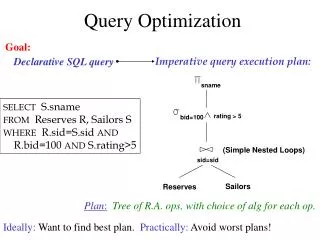
Query Processing and Optimization • Naive strategy • Fetch necessary XML data and store in Temp DB • Fetch necessary OLAP data and store in Temp DB • Join XML and OLAP data + perform XML-specific part of SQLXM query • Problem: too much data transferred to Temp DB • Rule-based optimization • Based on algebraic transformation rules • Partition query tree into OLAP part, XML part, and Temp part • Push as much evaluation to components as possible (always valid) • Cost-based optimization • Inline literal XML data values in OLAP queries • Efficient fetch of XML data over XPath interfaces • Caching/Prefetching in this particular setting • Focus of this paper DOLAP 2002 Workshop
Overview • Motivation • OLAP-XML federations • Federation system • Inlining • Optimizing XML retrieval • Caching and prefetching • Experimental results • Related work • Conclusion and future work DOLAP 2002 Workshop
Inlining • Problem: decorations used for selections are expensive • A lot of low-level OLAP data must be transferred to Temp • Solution: inlining • Get level expression predicate data from XML component • Transform predicate to refer to literal data values • Allows selection+aggregation to take place in OLAP component • Predicate length will be linear/quadratic in no of dim values • Queries may get too long • Split into partial queries • Inlining is particularly effective for OLAP systems • Allows more aggregation in OLAP component DOLAP 2002 Workshop
Inlining • Problem: what predicates to inline? • Exponential number of possibilities • Theorem: choosing the best inlining strategy is NP-hard • No obvious best choice • Often, an exhaustive search is feasible • Otherwise, two heuristics are used • Top down (see right above) • Start from no inlining and add • Will often fail • Bottom up • Start with all inlined and remove • Less likely to fail • General strategy • Generate all bottom up, except if cost goes up very much DOLAP 2002 Workshop
Optimizing XML Retrieval • XML component queries retrieve (locator,level exp) tables • Example tuple: (Aalborg, 160,000) • Easy to do in XQuery, but not in XPath • XPath can fetch only entire existing nodes • Many systems provide only an XPath interface • One query for every dimension value? • Often too much overhead because of many queries • Combining with OR/IN not possible as XPath result is unordered • Common parent of locator and level exp can be fetched • Larger data volume may have to be returned • Data for several level exps may be fetched together by combining XPath expressions • Algorithm for doing this in full paper • Cost analysis chooses between these options DOLAP 2002 Workshop
Caching and pre-fetching • General technique specialized for this particular domain • Caching/prefetching not feasible for very dynamic data • Given a new query tree the cache is checked • Identical query tree found: use cache (always fastest) • Lower part of query tree found: compare cost of using cache to not using it (not using cache may be faster due to OLAP pre-aggregation) • Caching and prefetching is done for component queries only • Entire federation queries take up too much space and has too little probability of reuse • XML cache • Raw XML data + temporary XML mapping tables • OLAP cache • Intermediate OLAP result tables • LRU cache replacement strategy used DOLAP 2002 Workshop
XML1 XML2 TEMP XML3 OLAP XML4 Time Cost Model • Federation cost model • Parallel exec of queries 1-4 • OLAP waits for 3+4 (inlined) • OLAP query not split • Results combined in Temp • OLAP cost model • CostOLAP = tOLAPOH+ tOLAPEval+ tOLAPTrans • Based on network+disk rate, selectivity, fact size, rollup fraction, cube size, and possibilities for using pre-aggregation • XML cost model • Based on assumption of constant data rate from a given document • CostXML = tXMLOH+ tXMLProc • Temp component used standard relational cost model • All models adapt based on real execution times • Details + parameter estimation in another paper DOLAP 2002 Workshop
Experiments • Test data • 50 MB TPC-H OLAP, 10MB preagg, 10 MB cache, 3 MB XML, • Behavior of different query types • Decoration, grouping, selection • Temp time generally short compared to OLAP and XML time • OLAP time generally highest • Inlining • Compared three cases (no, simple, and cost-based inlining) • Simple inlining 5 times faster than no inlining • Cost-based inlining • 3 times faster than simple inlining • 15 times faster than no inlining • Caching/prefetching • Remote data versus all data stored locally • Local evaluation 4-25 times faster than remote DOLAP 2002 Workshop
Experiments • Another experiment compared: • Our solution (flexibility optimal) • Physical integration (performance optimal) • Data • 1GB fact data based on TPC-H • 10MB XML data • 100 MB pre-aggregated data • Decoration, grouping, selection queries • All optimizations used • For ”typical” queries • The overhead of our solution was only 25-50% • Some queries will perform badly DOLAP 2002 Workshop
Related Work • Generic data integration • Relational, XML, semi-structured, OO,… + combinations • Do not consider OLAP DB properties such as automatic aggregation, dimension hierarchies and correct aggregation • Query processing and optimization for: • Data warehousing/OLAP • Federated, distributed, and multi-databases • Heterogeneous data • XML and semi-structured data • Does not address the special case of a federated OLAP environment • OLAP-object federations (own work) • Simple form of inlining • Does not consider cost-based optimization DOLAP 2002 Workshop
Conclusion and Future Work • OLAP handles schema changes and dynamic data poorly • Solution • OLAP-XML federations • Cost-based optimization needed • Three techniques presented • Inlining • Optimized XML retrieval • Caching and prefetching • Made OLAP-XML federation perform very well • Technology being implemented by OLAP query tool vendor • Future work • Further experimentation • Capturing document order • Getting measures from XML data DOLAP 2002 Workshop