Understanding Perception: Thresholds, Sensation, and Meaningful Organization
This chapter explores critical concepts in perception, focusing on thresholds for detecting stimuli, including absolute and subliminal thresholds. It distinguishes between sensation (the raw data) and perception (the interpretation), highlighting the transformation of meaningless sensations into meaningful information through organization. The chapter details structuralist and Gestalt approaches to perception, such as figure-ground organization, closure, similarity, proximity, and simplicity. It also touches on depth perception, illusions, cultural influences, and phenomena like clairvoyance and virtual reality, which affect our perceptual experiences.

Understanding Perception: Thresholds, Sensation, and Meaningful Organization
E N D
Presentation Transcript
perception Chapter 6
threshold • Perceived stimulus • Absolute threshold • > 50% chance of detecting stimulus • Subliminal threshold • < 50% chance of detecting stimulus • JND – just noticeable difference
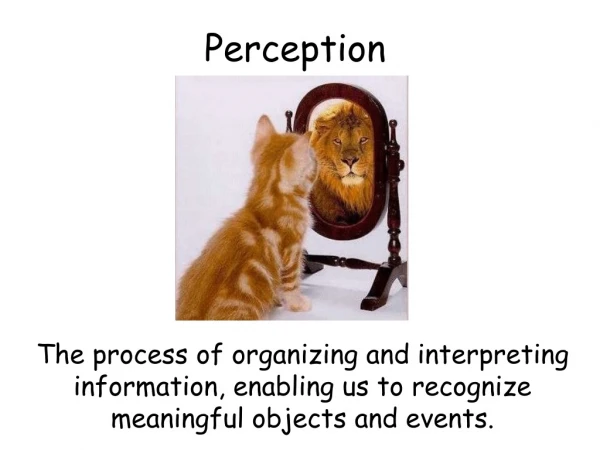
Sensation vs. perception • Act of changing sensations into perception • Meaningless to meaningful information • Organization • Structuralist – knit together bits • Gestalt – fixed set of rules
organization • Figure-ground • Closure • Similarity • Proximity • Simplicity • continuity • Constancy • Size • Shape • Brightness • Depth perception – 7 • Illusion – 4
Alternative perception • Cultural • Esp • Phi • Apparent • Virtual reality • First impressions • Clairvoyance