Understanding Membrane Structure and Function: The Essence of Cell Organelles and Permeability
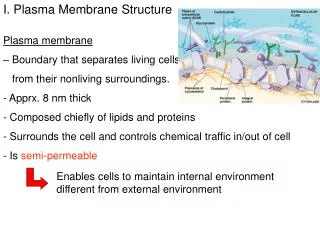
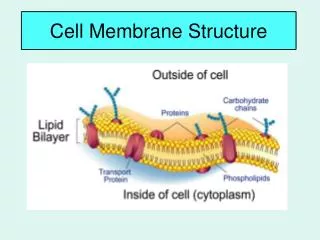
Membranes are fundamental to cellular organization, acting as permeability barriers that compartmentalize cells into organelles, each containing specific enzymes and macromolecules essential for cellular function. The synthesis and post-translational modification of membranes involve lipids and proteins, with lipids making up 45-50% of membrane mass, alongside proteins and carbohydrates. Different types of lipids, such as phospholipids and sphingolipids, contribute to the amphipathic nature of membranes, as established by milestones in membrane biology like the Fluid Mosaic Model.

Understanding Membrane Structure and Function: The Essence of Cell Organelles and Permeability
E N D
Presentation Transcript
Functions of Membranes Permeability barrier Compartmentalize the cell into organelles; organelles contain specific enzymes/ macromolecules Signal Transduction; receptor/ligand complex
Synthesis of membranes Plasma membrane ER Golgi Lysosomes/Endosomes Etc. Synthesis Post-translational of Lipids/ modification, Proteins processing, sorting
Composition of Membranes Lipids 45-50% (mass) Proteins 45-50% Carbohydrates ~5%
Types of lipids Phospholipids Sphingolipids Cholesterol
Phospholipid GlycerolFatty acid H O | || H - C - OH + HO - C - CH2 - CH2 - CH2 ------ | H - C - OH + HO - C - CH2 - CH2 - CH2 ------ + - | || R + (P) +HO - C - H O | H R-group and phosphate group carry charge (hydrophilic)
Phospholipid ester linkage GlycerolFatty acid (hydrophobic) H O | || H - C - O - C - CH2 - CH2 - CH2 ------ | H - C - O - C - CH2 - CH2 - CH2 ------ + - | || R + (P) - O - C - H O | H R-group and phosphate group carry charge (hydrophilic)
R - groups Serine Ethanolamine Choline Inositol Phosphatidyl Serine PS Phosphatidyl Ehtanolamine PE Phosphatidyl Choline PC Phosphatidyl Inositol PI
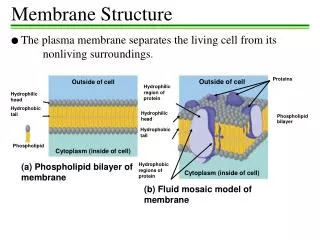
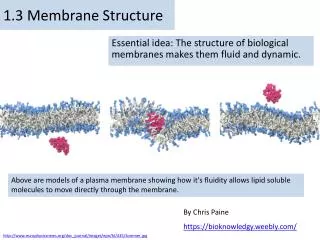
Phospholipids are amphipathic part hydrophilic part hydrophobic Simplified diagram
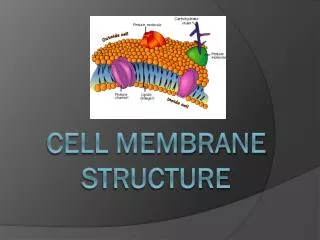
Milestones in Membrane Biology 1. Gorter and Grendel Lipid bilayer 2. Daveson and Danielli Lipid bilayer coated with proteins 3. J. David Robertson Unit Membrane = 7 nm 4. Singer and Nicolson Fluid Mosaic Model