Interference and Diffraction
This document explores the phenomena of interference and diffraction in waves, focusing on what occurs when two equal-magnitude pulses collide on a string. It discusses various outcomes, including reflection like a barrier, superposition effects leading to constructive and destructive interference, and the implications of wave diffraction around obstacles. Additionally, it highlights how different frequencies and waveforms combine, creating complex patterns and standing waves. Engage in the fascinating world of wave interactions and the principles driving them.

Interference and Diffraction
E N D
Presentation Transcript
Two Pulses • What happens when two pulses of equal magnitude move towards each other on a string? • A) Bounce off each other as if there was a barrier. • B) Bounce off each other as if there was an open string. • C) Pass through each other like the pulse wasn’t there. • D) Pass through with some loss of amplitude. • E) Annihilate each other.
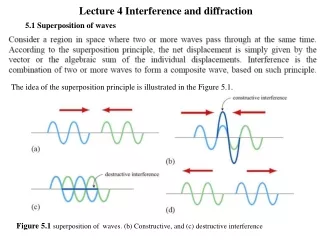
Superposition • When two or more waves are present at the same time they add together. • Includes different frequencies • Includes different wavenumbers • When waves are added at each point to form a new quantity, they are said to be in superposition.
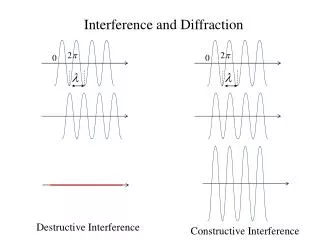
As pulses reach the same spot they add directly. At later times they still add. When two waves make a larger wave they have constructive interference. Constructive Interference
Waves in the opposite direction can cancel each other out. The waves still separately exist and may be moving. This is called destructive interference. Destructive Interference
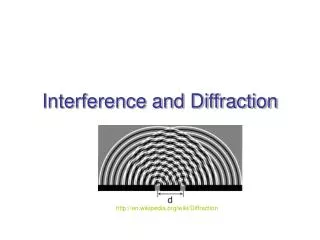
Ripples • Wave on the surface of water have both constructive and destructive interference. • Gaps where the ripples cross are from the destructive intereference.
Building a Square • Any wave form is the sum of harmonic waves. • One can construct a sequence of harmonic waves to match other shapes.
Small wavelength waves that encounter a large object leave a shadow area behind the object. Large wavelength waves that encounter an object leave less shadow area. This is called diffraction. Obstacles
When a wave reflects it sends the same frequency back again. There are two waves of the same frequency moving in opposite directions. This forms a standing wave. Standing Wave