Midpoint Calculation in Coordinate Plane and Mixed Number Operations
This content covers key mathematical concepts, including finding the midpoint of a line segment defined by its endpoints using coordinates and understanding distances between points on a line. It also addresses converting mixed numbers to improper fractions and applying multiplication and division rules for fractions, emphasizing the importance of simplification. The exercises not only help reinforce geometry concepts but also enhance skills in operations with mixed numbers. This fusion of topics supports a comprehensive understanding of fundamental math principles.

Midpoint Calculation in Coordinate Plane and Mixed Number Operations
E N D
Presentation Transcript
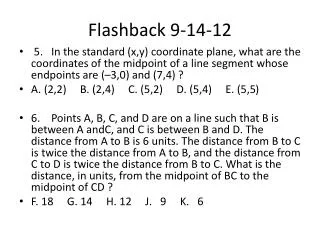
Flashback 9-14-12 • 5. In the standard (x,y) coordinate plane, what are the coordinates of the midpoint of a line segment whose endpoints are (–3,0) and (7,4) ? • A. (2,2) B. (2,4) C. (5,2) D. (5,4) E. (5,5) • 6. Points A, B, C, and D are on a line such that B is between A andC, and C is between B and D. The distance from A to B is 6 units. The distance from B to C is twice the distance from A to B, and the distance from C to D is twice the distance from B to C. What is the distance, in units, from the midpoint of BC to the midpoint of CD ? • F. 18 G. 14 H. 12 J. 9 K. 6
Joke of the day on a math test: 2+2
Multiplication and Division with Mixed Numbers • Change each Mixed Number into an Improper Fraction. • Follow the rules for Multiplying and Dividing Fractions.
Addition and Subtraction with Mixed Numbers • Add the Whole Numbers and then add the Fractions. Simplify. • Subtract the Fractions, then subtract the Whole Numbers. Simplify. • (Borrow, if necessary, if the fraction that you are subtracting is larger than the fraction you are subtracting from.)