Exploring Geometry and Symmetry in Functions and Asymptotes
This lesson delves into geometry, focusing on the distance calculation between two points across a stream using angles and trigonometric principles. It includes a problem involving the points A, B, and C, where angle measures guide the distance determination. Additionally, the lesson covers function symmetry, distinguishing even and odd functions with definitions and examples, and explains the concept of asymptotes, including vertical and horizontal boundaries for functions. Practice problems reinforce understanding of these mathematical concepts.

Exploring Geometry and Symmetry in Functions and Asymptotes
E N D
Presentation Transcript
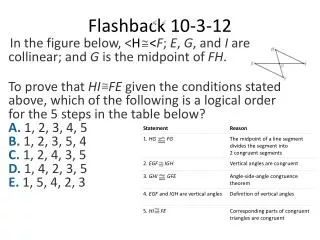
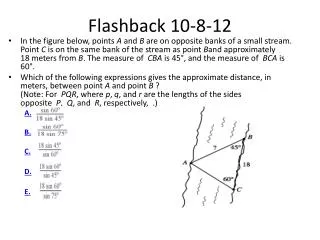
Flashback 10-8-12 • In the figure below, points A and B are on opposite banks of a small stream. Point C is on the same bank of the stream as point Band approximately 18 meters from B. The measure of CBA is 45°, and the measure of BCA is 60°. • Which of the following expressions gives the approximate distance, in meters, between point A and point B ?(Note: For PQR, where p, q, and r are the lengths of the sides opposite P, Q, and R, respectively, .) A. B. C. D. E.
Joke of the day What do you call more than one L?
Symmetry • A function that is symmetric to the y-axis is called an EVEN function. • A function symmetric to the ORIGIN is called an odd function. (This function looks the same upside down as it does right side up) • A graph that is symmetric to the x-axis is not a function.
To determine even/odd: • Algebraically: • Substitute –x into the function for x and see what comes out. • If f(-x) = f(x), the function is even. • If f(-x) = -f(x), the function is odd.
Examples Even Odd Neither • f(x) = x2 – 3 • f(-x) = • g(x) = x2 – 2x – 2 • g(-x) = • h(x) = x3 /(4 – x2) • h(-x) =
Asymptotes • An asymptote is a vertical or horizontal boundary of a function. • It tells where the function is going as the x or y values get very large or very small (∞, -∞) • We call the value that the function approaches a limit.
Examples • y = x___ x2 – x – 2
End behavior • y = 3x__ x2 + 1 • y = 3x2__ x2 + 1 • y = 3x3__ x2 + 1 • y = 3x4__ x2 + 1
HW: p. 103 Ex. 48-62 even, 63-66
Exit Slip p. 103 #67