Proving Collinearity and Function Domains: Understanding Key Mathematical Concepts
In this lesson, we explore the concepts of collinearity and the domains of functions. Given the conditions involving points H, F, E, G, and I, with G as the midpoint of FH, we aim to confirm the logical steps proving that HIFE. Additionally, we'll delve into domain restrictions in functions like f(x) = √(x + 3) and g(x) = (√x)/(x - 5). We'll discuss range expectations, continuity definitions, and types of discontinuities while solving specific exercises to enhance understanding.

Proving Collinearity and Function Domains: Understanding Key Mathematical Concepts
E N D
Presentation Transcript
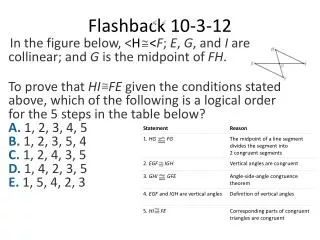
Flashback 10-3-12 In the figure below, <H<F; E, G, and I are collinear; and G is the midpoint of FH. To prove that HIFE given the conditions stated above, which of the following is a logical order for the 5 steps in the table below? A. 1, 2, 3, 4, 5 B. 1, 2, 3, 5, 4 C. 1, 2, 4, 3, 5 D. 1, 4, 2, 3, 5 E. 1, 5, 4, 2, 3
Joke of the day He said I was average -
Finding domain • Really finding what cannot be in the domain. • Ex. : f(x) = √(x + 3) • Think: What values would cause problems for us, assuming real number values? • Square root functions cannot have • So, • And the domain is
Try this one • Domain of g(x) = (√x)/ (x – 5)
How about this? • A(s) = (√3 /4) s2 where A(s) is the area of an equilateral triangle with side s.
Range • F(x) = 2/x • What do you expect it to be? • Graph it. • What does the range appear to be? • How can we confirm?
Continuity • A function is continuous if it has no gaps in the graph.
Discontinuous functions Removable • discontinuity • Jump discontinuity Infinite discontinuity
Exit Slip p. 104 #84