Prohibition and Women’s Suffrage: The Progressive Era’s Transformative Movements (1876-1916)
The Progressive Era (1876-1916) was marked by significant movements, particularly in temperance and women's suffrage. Organizations like the Women’s Christian Temperance Union (WCTU) and the Anti-Saloon League campaigned against alcohol, leading to the 18th Amendment in 1919. Meanwhile, women activists, facing opposition from diverse quarters, gained momentum for suffrage, culminating in the 19th Amendment in 1920. The era also saw key figures like Carrie Nation and Alice Paul, and highlighted racial issues sidelined by the Progressive movement. The intricate interplay of these movements shaped American society profoundly.

Prohibition and Women’s Suffrage: The Progressive Era’s Transformative Movements (1876-1916)
E N D
Presentation Transcript
Progressives-3 Domestic 1876-1916
Amendment 18 • Temperance: major issue before the Civil War • Back in 1870’s • Women and Protestant ministers • WCTU (Women’s Christian Temperance Union) • By 1879 militant under Francis Willard • 1911 had 245,000 members
Prohibition continued • 1893 Anti-Saloon League joined WCTU • Publicized problems: poverty, violence, unemployment • Opposition from immigrants, Catholics, working class, distillers (who also worked against women’s suffrage)
1917 Lever Act • Outlawed the use of grain to make alcoholic beverages • Due to war rationing • Consumption of alcohol increasing in some areas • By 1914, more than ¼ states were dry
1919 18th Amendment • Went into effect 1920 • Prohibited the manufacture, sale and transport of alcoholic beverages • WWI guilt • Big business and absenteeism • Not illegal to stockpile and drink it • W.C. Fields
The Volstead Act • Defined alcohol as any beverage having more than ½ of 1% alcohol • Also enforcement statute • Addicts: Wood alcohol, etc. went blind • Pot stills • Bathtub gin • Rum Runners
Prohibition and Organized Crime • Popular Nullification: Speakeasies, blind pigs, Rum Runners Grosse Pointe Basements and tunnels The Great Gatsby • Organized Crime: The Untouchables • Elliot Ness, Baby Face Nelson, Purple Gang, Al Capone
Prohibition continued • Production of sacramental wine in Church • Cough syrups • Repealed by Amendment 21 (Depression)
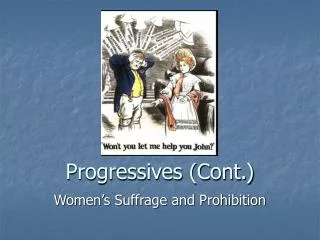
Women’s Suffrage • No backing from Wilson • Said it was up to the states • When he stroked out in second term, his wife ran the Whitehouse! • Women’s efforts for the vote was hurt by efforts for Prohibition • Whiskey distillers, etc. worked against Women’s Suffrage
Women’s Suffrage continued • 1910 Washington gave women the vote • First state in 14 years • By 1914, 6 more states • NWSA and AWSA: 20 year rift over 15th Amendment • Reunited and became NAWSA
Women’s Suffrage continued • Alice Paul and the Congressional Union • Brought militancy to the movement • England had just given women the vote • Chaining themselves to fences • Refused to eat in jail, force fed • Wilson was embarrassed • By 1919 39 states had given women the vote
Women’s Suffrage continued • Wilson gave up • Recommended it as a reward for work done in the war effort • 1920 19th Amendment • 1918 Jeanette Rankin (Montana) first woman in Congress. Voted against going to war in WwI and WWII
More about Women • Since Civil War: teachers and Nurses • 1900: 5% of all U.S. doctors were women • 1960: No change • 1909 ILGWU: Triangle Shirtwaist Co fire 1911 • New York City 146 killed • Much public sympathy= new laws and support
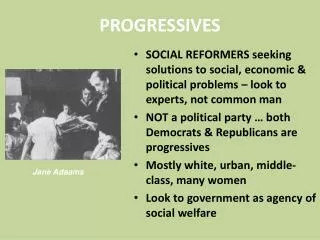
More about Women • By 1916 ¾ states had accident insurance laws • Social Feminists: • Jane Addams…Hull House (Chicago) • Lillian Wald…Henry Street Settlement (NYC) • Margaret Sanger…Planned Parenthood • 1915 National Birth Control League
More about Women • Women’s Clubs, Reformers, etc • Charlotte Gilman Women and Economics
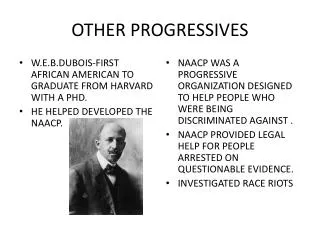
Remember • Racial issues: • Booker T. Washington and Atlanta Compromise • WEB DuBois and Niagara Movement • 1909 NAACP • Progressives did not address racial issues KKK will bloom again in the 20’s
Books • VeblenTheory of the Leisure Class: advocated economic management by economic engineers • Mary Baker Eddy 1879 Christian Scientist Science and Health: disease is caused by the mind alone
More Books • 1885 Reverend Josiah Strong Our Country: The Uncle Tom’s Cabin of the Social Gospel movement • Washington Gladden Applied Christianity • 1878 Salvation Army in England (Booth) Invaded America by 1879
The End of the Progressives • Big increase in Catholic population: 1870 6 million 1890 10 million Due to immigration from S. and E. Europe Education: Child Centered Progressive Dewey Not so much in the South Especially Black children