The Enlightenment Era: Reason, Revolution, and the Foundations of Modern Thought
The Enlightenment, often termed the "Age of Reason," was an 18th-century philosophical movement that rejected traditional social, religious, and political ideas in favor of rationalism and individuality. Key figures included John Locke, who championed natural rights and self-government, and Adam Smith, who introduced capitalist principles in economics. Influential works like Voltaire's "Candide" and Rousseau's "The Social Contract" emphasized freedom and democracy. Enlightened despots like Frederick the Great utilized these ideals to shape governance, laying the groundwork for modern democratic principles.

The Enlightenment Era: Reason, Revolution, and the Foundations of Modern Thought
E N D
Presentation Transcript
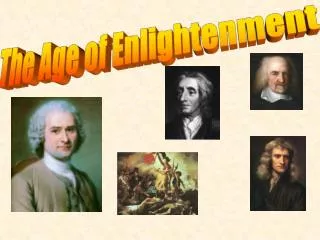
Enlightenment • “Age of Reason” • Philosophical movement in the 18th century. • Rejection of traditional social, religious, & political ideas. • Emphasis on rationalism & individuality.
Philosophes • Social critics in France during the 1700s • Met in salons • Influenced by England
Adam Smith • The Wealth of Nations (1776) • Economist: pro-capitalist • Gov shouldn’t regulate—Laissez-Faire • Defines economics in three “natural laws” • Productive when “self-motivated” • Competition = Balanced marketplace • Supply/Demand are product of free trade
Thomas Hobbes • English Philosopher – writes Leviathan (1651) • Man is evil • Strong gov (Absolute) • People have no rights • No right to rebel • Social Contract • Give up certain rights=order in society
John Locke • English –Two Treatises of Government (1690) & Declaration of Rights of Man (1690) • Against absolute rule • Self-government by people • Men are born equal and free • Natural Rights • Gov should protect rights • If they don’t = Revolution
Jean Jacques Rousseau • Swiss-Frenchman • The Social Contract (1762) • Individual freedom of people • Direct Democracy • Also used Social Contract • Inspired French Rev
Voltaire • Candide(1759) • Fought for religious freedom and freedom of speech
Montesquieu • French nobleman –The Spirit of Laws (1748) • Separation of Powers (Checks & Balances) • England’s System of Government • King/Ministers – Executive Power • Parliament – Legislative Power • Judges – Judicial Power • Idea later became basis for the US Constitution
CasareBeccaria • Italian, On Crimes and Punishments(1764) • Speak out in favor of fair and just punishments (No brutality) • People have the right to: • Fair & speedy trial • Not be tortured • No capital punishment.
Mary Wollstonecraft • English woman • A Vindication of the Rights of Women (1792) • Same rights as men • Education
Enlightened Despots • Kings or queens who rule with Enlightenment ideals • Frederick the Great • Maria Theresa • Joseph II of Austria • Catherine the Great