Download

1 / 6
60 likes | 182 Vues
This document discusses two correction techniques for beam tilt: the inner barrel hit method and the barrel-crossing pattern method. Both methods aim to correct the z-value discrepancies in tracking systems. Results from JDH and STT meetings reveal negligible differences in correction effectiveness, with slight advantages in simplicity and performance when using the barrel-only method. The findings indicate that both techniques are valid, but the barrel method is recommended for its consistency and reduced complexity.

E N D
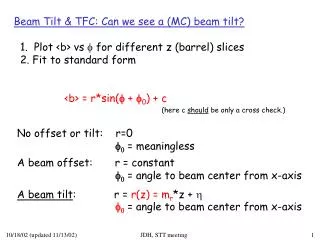
Beam Tilt & TFC: Which z value for correction? 1. Standing plan: correct using barrel of innermost hit 2. Alternate: also use barrel-crossing pattern Compare means of dz = track – barrel center for both 1 and 2. JDH, STT meeting
ZH->nnbb no beam tilt 6 for barrels 3 summary no tilt, expect r =0 f = random <b>, mm B1 B2 B3 f (degrees) B4 B5 B6 r, mm f, rad z, cm b, mm JDH, STT meeting
Tilt sample (Lorenzo) x, y=.5 mm/cm so expect mr=.7 mm/cm <b>, mm B1 B2 B3 f (degrees) B4 B5 B6 r, mm f, rad z, cm b, mm JDH, STT meeting
Tilt sample, again after applying barrel correction expect mr= 0 mm/cm f= random find, m consistent w/0! Slightly better b JDH, STT meeting
Tilt sample, again after applying barrel+layer correction expect mr= 0 mm/cm f= random find, m consistent w/0! Slightly better b JDH, STT meeting
Conclusions - either correction method alone beats none - negligible differences between the two methods - similar fit probabilities for flatness - identical impact parameter widths - barrel-only slightly better - slightly less physics dependence - simpler So stick with barrel only correction… ? JDH, STT meeting