Download
1 / 18
180 likes | 315 Vues
This session presented by Dr. Rose Mince, MS Kathy Doherty, and Mr. Barry Evans at the MSCHE Annual Conference discusses innovative partnerships between community colleges and four-year institutions aimed at improving assessment and student success. The presentation highlights the importance of seamless transfer pathways, personalized support, and effective communication between institutions. It explores successful existing partnerships, articulate agreements, and impactful initiatives that boost retention and graduation rates for increasingly diverse student populations. The insights provided aim to inform and guide future collaborations.

E N D
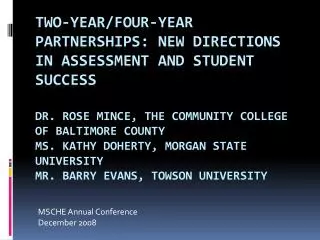
MSCHE Annual Conference December 2008 Two-year/Four-year Partnerships: New Directions in Assessment and Student SuccessDr. Rose Mince, the Community College of Baltimore County MS. Kathy Doherty, Morgan State UniversityMR. Barry Evans, Towson University
21st Century Higher Education Projections • Increasingly diverse student populations • Widely varying levels of secondary preparation • External calls for stringent accountability standards and procedures
The Value of Partnerships • Optimal use of resources and a focus on targeted initiatives to improve retention and graduation • Help ensure a citizenry prepared to lead the country into the second quarter of the new millennium • Students benefit from economies of scale, less duplication, and clear pathways to degree attainment
Using What We Know About Student Success CCBC • Faculty and Curriculum • Class Size • Individual Attention • Flexibility in Transfer • Clear Articulation TU • Engagement and Involvement • Focus and Support • Goals and Outcomes • Increased Opportunity
CCBC/TU Partnerships • Maintain the integrity of mission for each institution • Offer seamless transitions for students • Build upon existing relationships, and greatly expand current agreements • Require a great deal of trust and hard work • Involve faculty and staff from all areas of the institution
Value of Partnerships for CC Students • Seamless transfer, with no/little loss of credits • 40% of CCBC’s students enrolled in transfer programs • Students with Associates degrees have Junior level standing upon transfer • Transfer of all General Education credits • Early and accurate advising • Academic plan • Collegial relationships between faculty and administrators
Existing Partnerships • Student Learning Outcomes Assessment Projects • TU faculty serve as external consultants and “scorers” • Program Review Advisory Boards • TU is primary transfer institution for CCBC students • Shared Programs • Physician Assistant Program • Nursing Program
Existing Partnerships • Articulation Agreements/Articulation Team • Team meets regularly to update progress • Over time we have learned a great deal about the workings of each institution • TU Transition Program • Began in fall 2008 with 39 students • Expected to expand to 150 students in 2009 • 300 students in 2010
TU Transition Program • TU and CCBC Academic Partnership • Offer to a predetermined number of denied TU freshman applicants • Opportunity for enrollment with CCBC and instruction by CCBC faculty • Instruction conducted in TU classrooms • Invitation to live on TU campus • Availability of all TU freshman services
TU Transition Program: Benefits for Students • TU experience • All services provided on TU campus or Web • Quality education and transfer preparation • Possible TU enrollment in one or two terms • 3.0 and 12 credits for fall=spring TU transfer • 2.5 and 24 credits by spring=next fall TU transfer • University housing • Special support for student cohort • Included in the TU community • Tuition cost savings in some cases
Keys to Partnership Success • Two-way sharing and communication • Clear articulation agreements • On-site advising and transfer days at CC • An understanding of the transfer student experience • Responsiveness to the transfer student experience • The ability to build on what is known and yet to be known (trust and cooperation)
Applying the Partnership Principles • Refer to handout in presentation packet • SWOT: Strengths, Weaknesses, Opportunities and Threats for incorporating and/or expanding partnerships • Select one institution that you would like to work with • Identify some existing programs, agreements • Identify opportunities for growth, improvement
Assessing the Process and Results • Feedback from students, faculty and campus representatives via survey and focus groups • Demographic data and student success data • Transfer, retention and, eventually, graduation rates • Student success post-program • Number recruited for second year of program • Revisions to second year of program based on year 1 results
Conclusions • The pathway to the future builds on two-year/four-year partnerships that meet the needs of an increasingly diverse student population with evolving needs and goals • Partnerships are informed and reinforced by efficiency of resource utilization and data driven decision making • An active and systematic assessment of the outcomes supports the continuation and expansion
Conclusions • Partnerships mandate adaptability and flexibility • New directions in student success are shaped by the needs of the millennial population, advanced by effective and streamlined partnerships, and secured through demonstration of impact and value-added