Moocs and Educational Gaming
This resource explores the concepts of Massive Open Online Courses (MOOCs) and Educational Gaming, highlighting their impact on contemporary education. MOOCs, originating in 2008, provide diverse and accessible learning opportunities. With institutions like UC Berkeley and Stanford at the forefront, these courses blend formal education with online engagement. Additionally, the benefits of educational gaming are examined, showcasing how games foster motivation, personalized learning, collaboration, and skills development. Discover how these innovative approaches are transforming the educational landscape.

Moocs and Educational Gaming
E N D
Presentation Transcript
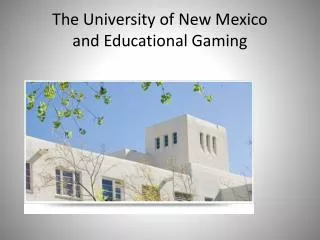
Moocs and Educational Gaming By John Berglund Daniel Bottehsazansean Brady
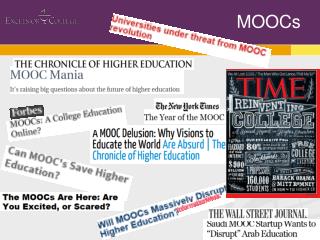
What are Moocs? • A massive open online course • Free web based distance learning program • Pay for accreditation • 2012 year of the MOOCs
History of Moocs • 2008 the term MOOCs was coined by Dave Cormier and Brian Anderson • Response to a course at University of Manitoba CCK08 • 25 paying students and 2200 free users • Connectivism and connective knowledge
Where to get accredited • UC Berkley • Stanford • Harvard • Johns Hopkins • 5-9 weeks with a certification of completion
Video • http://www.youtube.com/watch?v=eW3gMGqcZQc
Educational Gaming • Games that are designed to help people expand concepts • Understanding an historical event or culture. • Games types are board, card and video game
How to locate educational games • Try the internets! • http://gaming.psu.edu/ • http://www.funbrain.com/ • http://www.youtube.com/watch?v=30oZ7WVdheg
Why Gaming? • 97% of US teens play digital games on a regular basis • Gaming can be described as a system in which players engage in artificial conflict, defined by rules, that results in a quantifiable outcome • Elements of “gamification” applied to traditional teaching increase motivation or engagement
Five major characteristics/claims: • (1) are built on sound learning principles • (2) provide more engagement for the learner • (3) provide personalized learning opportunities • (4) teach 21stcentury skills • (5) provide an environment for authentic and relevant assessment
Games are Built on Sound Learning Principles • Play is an important element for healthy child development • Children learn through imaginative play • Games provide an opportunity to think, understand, prepare, and execute actions • Games also are built with clear goals and provide immediate feedback
Games Provide More Engagement for the Learner • Digital games can be more engaging than regular classroom activities • Ability to sustain engagement and motivation across time • A European study demonstrated that gaming increased student motivation/engagement
Games Provide Personalized Learning Opportunities • Identifies strengths and weaknesses • Develops teaching strategies based on student need • Provides engaging curriculum choices
Games Teach 21st Century Skills • Many games take advantage of technology that is familiar to students and use relevant situations • Provides the ability to interact with other learners and trained professionals • Games foster collaboration, problem-solving, and procedural thinking
provide an environment for authentic and relevant assessment • Games provide a means for quantifying knowledge level and abilities • Assessment occurs as the game engine evaluates players’ actions and provides immediate feedback • Assessment occurs naturally in a game: players make progress or they don’t • Analytical tools rate the success of students throughout the entire range of a game
Example • http://player.piksel.com/player.php?p=wow8r9la
References • http://en.wikipedia.org/wiki/Massive_open_online_course • http://en.wikipedia.org/wiki/Educational_game • http://gaming.psu.edu/ • http://www.youtube.com/watch?v=eW3gMGqcZQc • http://researchnetwork.pearson.com/wp-content/uploads/Lit_Review_of_Gaming_in_Education.pdf