Understanding Sound Waves: How the Ear Processes Hearing
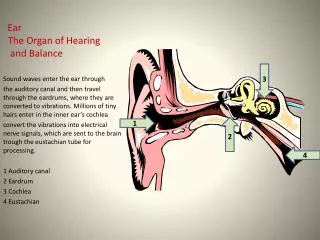
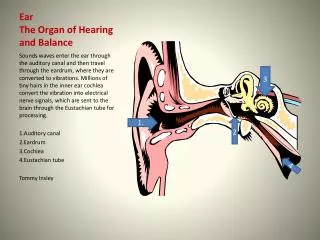
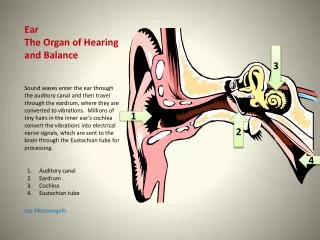
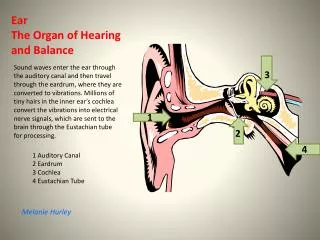
The ear is a remarkable organ capable of detecting a broad spectrum of sound waves. It consists of three main parts: the outer ear, middle ear, and inner ear, each playing a vital role in hearing. Sound waves are collected by the outer ear, directed through the ear canal, and vibrate the eardrum. These vibrations are transmitted to tiny bones in the middle ear and then to the inner ear, where tiny hairs convert them into nerve impulses. The brain then interprets these impulses, enabling us to perceive sounds of varying pitch and loudness.

Understanding Sound Waves: How the Ear Processes Hearing
E N D
Presentation Transcript
Sound Waves 2 Hearing and the Ear • The ear is a complex organ that can detect a wide range of sounds. • The ear can be divided into three parts—the outer ear, the middle ear, and the inner ear.
Sound Waves 2 Hearing and the Ear
Sound waves are gathered by the outer ear which is shaped to help capture the sound waves (energy transferred in particles of air) and send them through the ear canal, which transfers them to the eardrum.
The vibrations of air particles cause the eardrum to vibrate.
Pitch is the human perception of the frequency sound. If the vibrations follow each other slowly (low frequency) the sound is heard as a low pitch. If the vibrations follow each other in rapid succession (high frequency), the sound is heard as a high pitch.
Sound waves with large amplitudes push on the eardrum with more force and are heard as loud sounds. Sound waves with small amplitudes push on the eardrum with less force and are heard as soft sounds.
Vibrations from the ear drum are transmitted to three small bones of the middle ear, which transmit the vibrations to the inner ear.
The vibrations in the liquid of the inner ear cause the tiny hairs to vibrate. The vibrating tiny hairs transmit the energy to nerves attached to the hairs. The nerve impulses are transmitted to the brain and interpreted as hearing.