Download
1 / 8
90 likes | 255 Vues
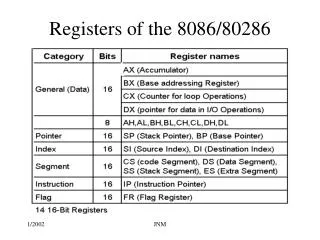
The 8086 microprocessor architecture features several key registers essential for data handling and instruction execution. General registers include AX, BX, CX, and DX, with sub-registers AH/AL, BH/BL, CH/CL, DH/DL for 8-bit operations. The index registers (SI and DI) facilitate data storage and address offsets. Pointer registers like BP and SP are crucial for stack operations, while the Instruction Pointer (IP) directs the flow of execution. Segment registers (CS, DS, ES, SS) maintain segment addresses, organizing code, data, and stack information in memory.

E N D
8086 Registers Module M14.2 Sections 9.2, 10.1
General Registers Accumulator AX AH AL Base register BX BH BL General Registers Count register CX CH CL Data register DX DH DL 8 bits 16 bits Many instructions in a computer program involve moving data into and out of these general registers.
Index Registers Source SI Index Registers Destination DI Index registers may be used to store 16-bit data. Index registers are also used as pointers to offset addresses in memory. MOV AL,[SI] means move into AL the byte in the data segment at the offset address that is in SI.
Pointer Registers Base BP Stack SP Pointer Registers Instruction IP The Instruction Pointer, IP, contains the offset address of the next instruction to be executed. The Stack Pointer, SP, contains the offset address of the top of the stack. The Base Pointer, BP, is used to access data in the stack segment.
Segment Registers Code CS Data DS Segment Registers Extra ES Stack SS Segment registers contain segment addresses. The Code segment contains the program being executed. The Data segment contains data (variables). The Extra segment can be used for anything. The Stack segment contains the stack.


![8086 [2]](https://cdn1.slideserve.com/2457127/8086-2-dt.jpg)