
SlideServe
Menu
Préférences
© SlideServe · v2026

Everyday Use Short Story by Alice Walker

regan-buchanan avatar
12 diapositives · 820 Views · Nov 28, 2014

Everyday Use Short Story by Alice Walker. Introducing the Short Story with Literary Analysis: Conflict and Character Reading Skill: Make Inferences Vocabulary in Context. VIDEO TRAILER. INTRODUCING THE SHORT STORY. What makes something VALUABLE?.
Everyday Use Short Story by Alice Walker - slide 1
01 / 12Everyday Use Short Story by Alice Walker
1 / 17

Télécharger la présentation

Everyday Use Short Story by Alice Walker
Une image / un lien ci-dessous est fourni (tel quel) pour télécharger la présentation

Politique de téléchargement : le contenu du site vous est fourni TEL QUEL pour votre information et votre usage personnel ; il ne peut être vendu, concédé sous licence ni partagé sur d’autres sites sans l’accord de son auteur.Le contenu vous est fourni TEL QUEL, pour votre information et votre usage personnel uniquement. Téléchargez la présentation en cliquant sur ce lien. Lors du téléchargement, si vous ne parvenez pas à télécharger une présentation, l’éditeur a peut-être supprimé le fichier de son serveur.Pendant le téléchargement, si vous ne parvenez pas à obtenir une présentation, le fichier a peut-être été supprimé par l’éditeur.

F I N

Plus de contenu associé

Transcription de la présentation
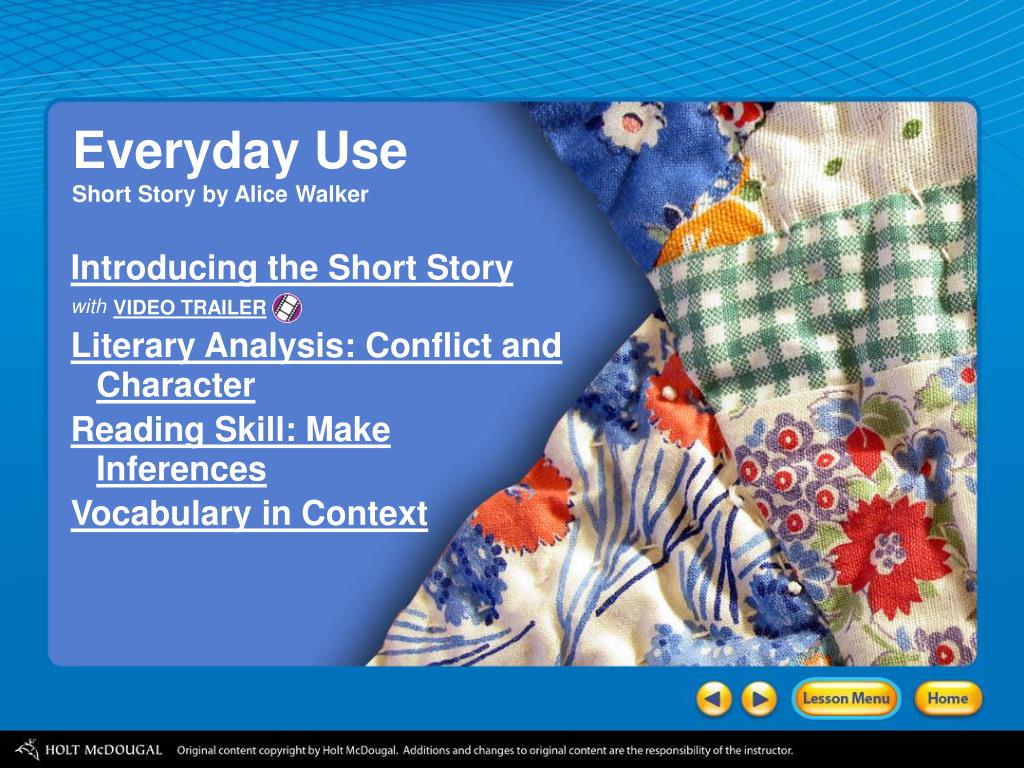
  1. Everyday Use Short Story by Alice Walker • Introducing the Short Story • with • Literary Analysis: Conflict and • Character • Reading Skill: Make • Inferences • Vocabulary in Context VIDEO TRAILER

  2. INTRODUCING THE SHORT STORY What makes something VALUABLE? The word value means different things to different people. For example, an old vase might have high monetary value or high sentimental value.

  3. INTRODUCING THE SHORT STORY What makes something VALUABLE? To some, it might have great historical, cultural, or artistic value. But others might think it’s a useless piece of junk. Often people disagree over the value they assign to an object. Or they may agree that it is valuable, but not for the same reason.

  4. INTRODUCING THE SHORT STORY What makes something VALUABLE? QUICKWRITE If you could save only one precious possession of yours from being destroyed or left behind, what would you save? Write a short paragraph identifying the item and telling why it is valuable to you.

  5. Click on the title to play the trailer. Everyday Use

  6. Conflict and Character A story’s plot progresses because of a conflict, or struggle between opposing forces.

  7. Conflict and Character In “Everyday Use,” the main conflict centers around two sisters, Dee and Maggie, and their mother, who narrates the story. Although the main conflict between these characters is worked out in the resolutionof the story, some other conflicts linger unresolved.

  8. Conflict and Character As you read, pay attention to the conflicts and whether they are resolved. Also think about the differences in the characters’ values and priorities.

  9. Make Inferences Because writers don’t always tell you everything you need to know about a character, you must make inferences, or logical guesses, based on story details and your own experiences. For example, the narrator makes a comment about her yard being like “an extended living room.” From this comment, you might infer that she enjoys being outdoors.

  10. Make Inferences As you read, notice what the characters’ words and actions tell you about their personalities and attitudes. Take notes on a chart like the one shown. Story Details Inferences thinks orchids are tacky flowers is pretentious Dee Mama Maggie

  11. doctrine furtive heritage recompose Figure out the meaning of each boldfaced vocabulary word from the context. Sample answers appear in brackets. In your Reader/Writer Notebook, write a sentence that shows your understanding of each word. 1. sneaky, furtivebehavior [secretive] 2. need time to recomposeafter your outburst [become calm again] 3. accept the club’s doctrine [set of rules] 4. remember your heritagewhen you leave home [family traditions]

  12. doctrinen. a set of rules, beliefs, or values held by a group furtiveadj. sneaky, secretive heritagev. something passed down through generations, such as traditions, values, property recomposev. to restore to calm, to settle again