SlideServe
Menu
Préférences
© SlideServe · v2026

William Butler Yeats (1865-1939)

remington-ronnie avatar
21 diapositives · 399 Views · Oct 27, 2014

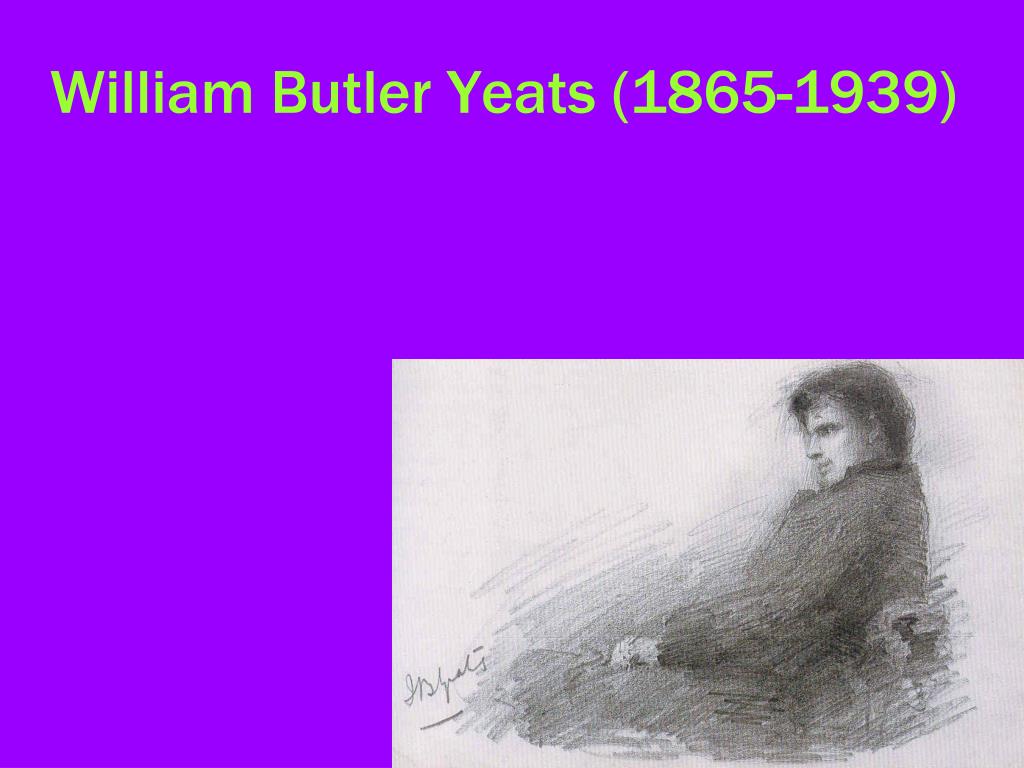
William Butler Yeats (1865-1939). William Butler Yeats (1865-1939). Prominent Irish literary figure Member of Rhymers Club Fascinated with myth Wants to re-make myths and symbols. Image borrowed from: http://encarta.msn.com/find/MediaMax.asp?pg=3&ti=029FB000&idx=461535406.
William Butler Yeats (1865-1939) - slide 1
01 / 21William Butler Yeats (1865-1939)
1 / 17

Télécharger la présentation

William Butler Yeats (1865-1939)
Une image / un lien ci-dessous est fourni (tel quel) pour télécharger la présentation

Politique de téléchargement : le contenu du site vous est fourni TEL QUEL pour votre information et votre usage personnel ; il ne peut être vendu, concédé sous licence ni partagé sur d’autres sites sans l’accord de son auteur.Le contenu vous est fourni TEL QUEL, pour votre information et votre usage personnel uniquement. Téléchargez la présentation en cliquant sur ce lien. Lors du téléchargement, si vous ne parvenez pas à télécharger une présentation, l’éditeur a peut-être supprimé le fichier de son serveur.Pendant le téléchargement, si vous ne parvenez pas à obtenir une présentation, le fichier a peut-être été supprimé par l’éditeur.

F I N

Plus de contenu associé

Transcription de la présentation
  1. William Butler Yeats (1865-1939)

  2. William Butler Yeats (1865-1939) • Prominent Irish literary figure • Member of Rhymers Club • Fascinated with myth • Wants to re-make myths and symbols Image borrowed from: http://encarta.msn.com/find/MediaMax.asp?pg=3&ti=029FB000&idx=461535406

  3. William Butler Yeats (1865-1939) • Begins to see his poetry linked to Irish culture • Becomes fascinated with Irish lore Image borrowed from: http://encarta.msn.com/find/MediaMax.asp?pg=3&ti=029FB000&idx=461535406

  4. William Butler Yeats (1865-1939) • Comes to detest the middle classes • Likes the rich and the peasants

  5. William Butler Yeats (1865-1939) • Becomes invested in Irish politics • Becomes Senator of Irish Free State

  6. Maud Gonne • Yeats’s long-time obsession Image borrowed from: http://www.yeats-sligo.com/html/wbyeats/influences.html

  7. Lady Gregory • Important figure in creating Irish National theatre • Collaborates with Yeats Image borrowed from: http://www.yeats-sligo.com/html/wbyeats/influences.html

  8. Irish National Theatre • Important site for Irish literary politics • Dramatists like Yeats and Lady Gregory re-tell Irish history and stories • Plays often included political overtures Image borrowed from: http://www.yeats-sligo.com/html/wbyeats/drama.html

  9. Celtic Renaissance • 1885-1939—death of Yeats • Return to Irish history, legend, folklore, and native literary models • Most of the writing was still in English • AE (George Russell), Lady Gregory, John Millington Synge, Sean O’Casey, James Joyce, Samuel Beckett, Edna O’Brien, Eavan Boland

  10. “Easter 1916” (1920) • Vital poem to Modern Irish politics • Recalls prominent event in Modern Irish politics—Easter Rebellion • Haunting Imagery

  11. “Easter 1916” (1920) • “They lived minute by mine” • “Too long a sacrifice—makes stone of heart”

  12. “The Second Coming” (1921) • 2106: “uncontrollable falcon” • Allusion to Mid-Summer Night’s Dream by William Shakespeare • Second coming at hand

  13. “Leda and the Swan” (1928) • Recalls mythical rape of Leda by Zeus disguised as swan • Sexual encounter becomes assault • Recalls fall of Troy

  14. T.S. Eliot (1888-1965) • American born—becomes English • Dominant voice in Modernist Age • Formal poetic experimentation • 1922: Wasteland—may be the most important poem of the 20th century Image borrowed from: http://www.foss.jcu.edu.au/Course_Info/el1005/eliot.htm

  15. T.S. Eliot (1888-1965) • Felt poetry must become comprehensive • Sought to revive poetry that had become dead • Has close ties to Romanticism • Really wants to revive classic aesthetic Image borrowed from: http://www.poets.org/poets/poets.cfm?prmID=18&CFID=5917387&CFTOKEN=13671866

  16. T.S. Eliot (1888-1965) • Many allusions and literary references • Early poetry concerned with wasteland imagery Image borrowed from: http://www.empirezine.com/deadpoets/thomas-sterns-eliot.htm

  17. T.S. Eliot (1888-1965) • Late poetry and drama concerned with religious matters • Later poems have much calmer poetic • “Tradition and Individual Talent” Image borrowed from: http://www.geocities.com/Athens/Acropolis/5616/bio.html

  18. “The Love Song of J. Alfred Prufrock” (1917) • “sky like etherized patient” • Women coming and going http://www.salon.com/audio/2000/10/05/eliot/index.html

  19. “The Love Song of J. Alfred Prufrock” (1917) • 2365: “Time for indecisions” • Time to wonder, “Do I dare?” • 2366: “Should I force the moment?” • Reference to John the Baptist myth

  20. “Journey of the Magi” (1927) • Dramatic monologue/lyric • 2386: “worst time of year to travel” • Hard journey

  21. “Journey of the Magi” (1927) • “Was it for birth or death?” • “This birth was like death for us” • Returned to native land with alien people clutching their gods