Understanding Proof by Contradiction in Discrete Structures
This resource provides a comprehensive look into the method of proof by contradiction, a crucial technique in discrete structures and computer science. It explains when and how to apply this method, illustrating scenarios where proving the non-existence or impossibility of a statement is necessary. Examples include demonstrating that there are infinitely many prime numbers and the limits of compression algorithms. The guide emphasizes the importance of recognizing when to use various proof types and highlights the potential pitfalls when using contradiction.

Understanding Proof by Contradiction in Discrete Structures
E N D
Presentation Transcript
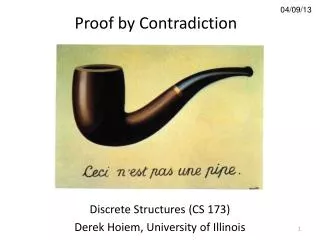
Proof by Contradiction 04/09/13 Discrete Structures (CS 173) Derek Hoiem, University of Illinois
Administrative • Homeworks due Wed • Tests released during discussion sections • Grades released shortly before (Wed at earliest) • Honors HW 2 posted (due Apr 29)
About conflict exams for final • Look for posted conflict exams that might help out. These are largely from courses with combined exams. CS 173, like most non-combined exams, doesn't have one. • Two exams at the same time? The course with the combined exam handles it. (Or, if there's more than one, the largest such course.) • Three exams in a row? The largest course handles it. • Really large combined exams often have an unposted "conflict conflict" time already set up, that you'll only find out about after you report a conflict to their course staff. • Conflicts must be reported to instructors by the last day of classes. Earlier is better. If you aren't 100% sure which course is handling it, notify all the instructors involved, so we can help make sure you end up with a solution. • More details are on the student code exams page
Last class • Analysis of running time of code • P vs. NP: Problems in NP can be verified in polynomial time. Problems in P can also be solved in polynomial time. • This class • Proof by contradiction • When to use different types of proofs
Proof by Contradiction • Sometimes you want to show that something is impossible • cannot be written as a ratio of integers • There is no compression algorithm that reduces the size of all files • A cycle with an odd number of nodes can’t be colored with two colors • Difficult to prove non-existence directly, and can’t prove by example • Solution: show that the negation of the claim leads to a contradiction
Contradiction A set of propositions is a contradiction if their conjunction is always false Contradiction? and is odd is negative number and is real
Proof by contradiction Claim: There are infinitely many prime numbers Equivalent claim: There is not a finite set of primes.
Basic form of proof by contradiction • I need to show proposition • Suppose, instead, that is false. • Then, we can see that both and, which is a contradiction. • Therefore, must be true.
Why proof by contradiction works We need to prove proposition Instead, we show , i.e., that we can conclude a contradiction from not By contrapositive,
Another explanation We need to prove proposition Instead, we show , i.e., that we can conclude a contradiction from But means that , so
Danger of proof by contradiction: a mistake in the proof might also lead to a contradiction See this blog post about P=NP problem http://rjlipton.wordpress.com/2011/01/08/proofs-by-contradiction-and-other-dangers/
Proof by contradiction Claim: is irrational Equivalent claim: There does not exist a pair of integers without common factors such that
Proof by contradiction Claim: No lossless compression algorithm can reduce the size of every file.
Lossless compression (PNG) • Predict that a pixel’s value based on its upper-left neighborhood • Store difference of predicted and actual value • Pkzip it (DEFLATE algorithm)
Proof by contradiction Claim: A cycle graph with an odd number of nodes is not 2-colorable.
Proof by contradiction or contrapositive Claim: For all integers , if is odd, then is odd.
When to use each type of proof Match the situation to the proof type Situation • Can see how conclusion directly follows from hypothesis • Need to demonstrate claim for an unbounded set of integers • Easier to show that negation of hypothesis follows from negation of conclusion • Need to show that something doesn’t exist • Need to show that something exists Proof type • Direct proof • Proof by example or counter-example • Proof by contrapositive (or logical equivalence) • Induction • Proof by contradiction
When to use each type of proof Match the situation to the proof type Situation • Can see how conclusion directly follows from claim (a) • Need to demonstrate claim for an unbounded set of integers (d) • Easier to show that negation of hypothesis follows from negation of conclusion (c) • Need to show that something doesn’t exist (e) • Need to show that something exists (b) Proof type • Direct proof • Proof by example or counter-example • Proof by contrapositive (or logical equivalence) • Induction • Proof by contradiction
When to use each type of proof Match the claim to the suitable proof type Claim • There is no real , such that • If is odd, then is odd. • There is an integer , such that . • If is odd, then is odd. • All trees have more nodes than edges. • A wheel graph can’t be colored with two colors. • Not every natural number is a square. • The sum of two rational numbers is rational. • An even number can’t be created from the product of odd numbers. Proof type • Direct proof • Proof by example or counter-example • Proof by contrapositive (or logical equivalence) • Induction • Proof by contradiction
Next class • Collections of sets • Sets of sets • Powersets • Partitions