
Digestion
E N D
Presentation Transcript
Digestion Chapter 49
49-1: Nutritional Requirements Cells need: • Water • Carbohydrates • Lipids • Proteins • Nucleic acids • Vitamins-- Study Table 49-1 pg. 980 • Minerals - Table 49-2 pg. 981
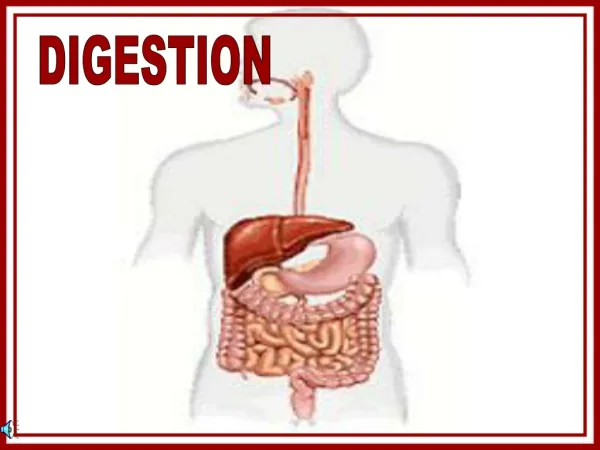
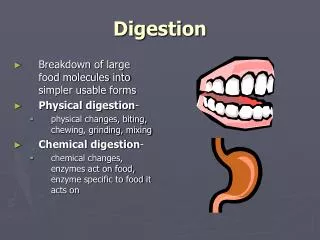
Nutrition involves the following steps: • Ingestion • Digestion • Absorption • Distribution Digestion: the breakdown of ingested food materials into molecules that can be delivered to and utilized by the individual cells. • Can be both mechanical and chemical. • human anatomy tutorials, labeled with explanations (all systems) link
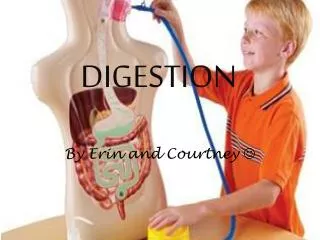
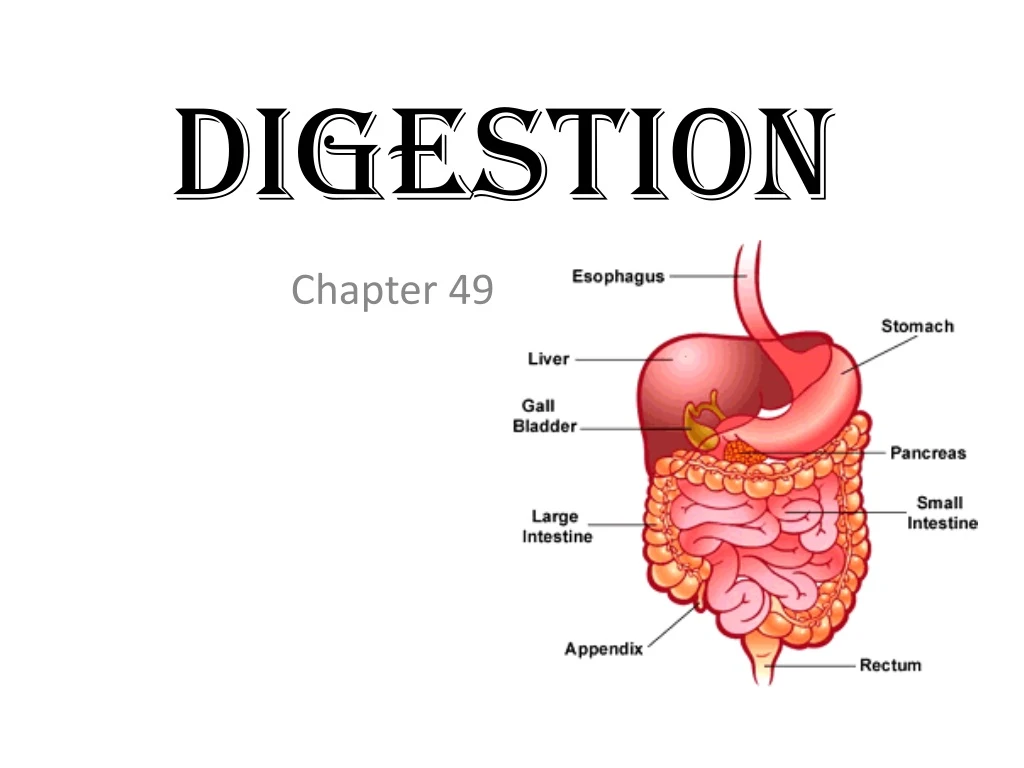
The “Gut” (Gastrointestinal Tract): Fig.49-2 pg. 983 • Made of 4 layers (see pictures on page 985) • Mucosa: (innermost) -epithelial, connective, some smooth muscle • Submucosa: connective, nerve fibers, blood & lymph vessels • MuscularisExterna: muscle tissue (circular & longitudinal) • Serosa: outer covering of connective tissue
Peristalsis: coordinated contractions of circular muscles along digestive tract which move food along • Sphincters: thickened, heavy bands of muscle along tract that act as valves by contracting (closing) and relaxing (opening) to control of materials
The Oral Cavity: Initial Processing: Mechanical Digestion • Tongue - swallowing (microscopic picture) • Teeth: “mastication” (chewing) • incisors- cutting, clipping • canines- tearing, stabbing • premolars- "bicuspids" 2 cusps (points) • molars- 4 or 5 cusps (for grinding) • Other Animals lack teeth, have alternatives: • rasping tongue: ex- snails, lamprey, frogs • grinding organ (gizzard): ex- birds, earthworms Chemical Digestion (enzymatic hydrolysis): saliva, mucous • 3 pairs of salivary glands and buccal glands in jaw: lubricates, softens food • Enzyme- salivary amylase for hydrolysis of starch into smaller sugar molecules; slightly alkaline (sodium bicarbonate)
The Pharynx & Esophagus: Swallowing Swallowing: passage of food to the esophagus ----> stomach • begins as voluntary action (striated muscles in upper part of esophagus) lower portion involuntary (smooth muscle)= "peristalsis" Esophagus opens into Stomach • Abdominal cavity lined with peritonium / organs are suspended by mesentaries (animation)
The Stomach: Storage & Liquefaction …a collapsible, muscular, j-shaped bag with many folds and ridges • mucosal lining folds into gastric pits (microscopic picture) • lined with mucous-secreting epithelial cells • gastric glands secrete HCl and pepsinogen (precurser to pepsin) • pH between 1.5 & 2.5 (mucous barrier between acids + stomach lining )- ulcers?
Stomach acids, enzymes HCl: • kills bacteria loosens tissues for digestion converts pepsinogen to pepsin Pepsin: breaks down proteins into smaller peptides • Semi-liquid mass "Chyme" moves to lower end of stomach => Pyloric Sphincter (takes about 4 hrs.) • Rate of leaving stomach = H2O,carbs, proteins, fat, protein/fat combo • The three phases of gastric secretion animation
The Small Intestine: Digestionand absorption • lined with VILLI( microscopic fingerlike projections) and tiny microvilli on surface of epithelial cells • about 21 feet long (adult), total surface area about 300 m2 Digestion: • Duodenum- 1st 25 cm (10 inches) • most digestion takes place here; • receives several digestive juices/enzymes from ducts leading from ACCESSORY GLANDS (liver pancreas, gall bladder)
Accessory Glands • neutralize stomach acids with alkaline secretions • produces several enzymes to chemically digest nutrients
The Pancreas Enzymes made here enter the duodenum via the pancreatic duct • Amylase: continues starch digestion • Starchesdisaccharidesmonosaccharides • Trypsin: breaks down proteins amino acids • Lipase: hydrolyzes fats
The Liver: an accessory gland Bile- • produced by liver • stored in gall bladder • contains salts (emulsify fats) • sodium bicarbonate (neutralize pH to optimum 7 or 8)
Absorption of Nutrients: • food is absorbed through epithelial cells of intestinal mucosa into the bloodstream, for distribution to all cells • Active Transport: Monosaccharides, Dipeptides, Amino Acids • Diffusion: fatty acids • Lipids resynthesize into triglycerides, phospholipids (blood & lymph vessels), Cholesterol
The Large Intestine: Water Absorption & Elimination The Large Intestine (colon)continues absorption of water, sodium, and other minerals (which begins in small intestine) • E. coli bacteria: makes Vit.K, amino acid synthesis • Appendix: vestigial organ (gastric caecum?) • Waste: "fecal matter" • water, bacteria, dead cells, indigestible matter (cellulose) • lubricated with mucus • temporary storage in rectum