Understanding Ecological Succession and Community Dynamics in Ecosystems
Explore the intricate processes of ecological succession, focusing on the interactions between biotic and abiotic factors that shape diverse communities. Learn about autotrophs and heterotrophs, the significance of limiting factors, and the concepts of tolerance and habitat change. Dive into primary and secondary succession, illustrating how ecosystems recover and transform after disturbances like fire or human impact. Discover how species adapt in rural, urban, desert, and arctic communities, enhancing our understanding of ecological balance and stability.


Understanding Ecological Succession and Community Dynamics in Ecosystems
E N D
Presentation Transcript
Review Terms • Abiotic: Non-Living factors in an environment • Biotic: Living factors in an environment • Autotroph: makes its own food • Heterotroph: goes out and gets food • Herbivore, Carnivore, Omnivore, Detritivore
Community • A group of interacting populations that occupy the same area at the same time • Are organisms in all communities the same? • NO! • What lives in a rural community? • What lives in an urban community? • What lives in a desert community? • What lives in an arctic community?
Limiting Factors • Any ABIOTIC FACTOR that restricts the numbers, reproduction or distribution of organisms • Can include: sunlight, climate, temperature, water • BIOTIC LIMITING FACTORS include LIVING things, such as other plant and animal species • Factors that are LIMITING FACTORS for one species might help another thrive
TOLERANCE • The ability of an organism to survive when subjected to biotic and abiotic factors • Includes upper and lower limits of any environmental factors • Example: water temperature for fish
Ecological Succession • Ecosystems are constantly changing • Can be small ways (a tree falling) or Large ways (forest fire) • Some ecosystems depend on fires to clear debris to prevent worse damage • If fire is prevented debris might build up to the point that the next fire would burn all shrubs and trees • Habitats can be changed so drastically by fire that some species can no longer live there
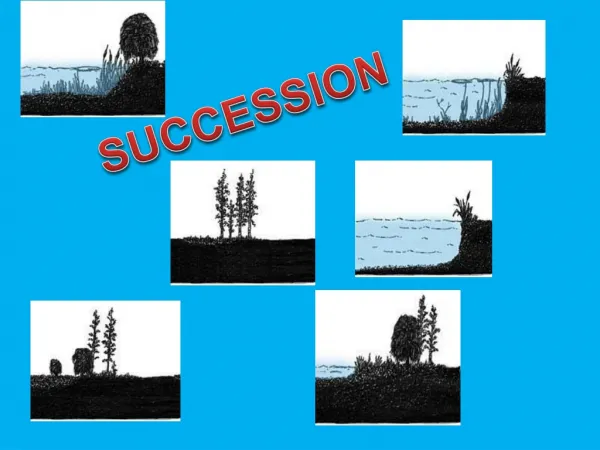
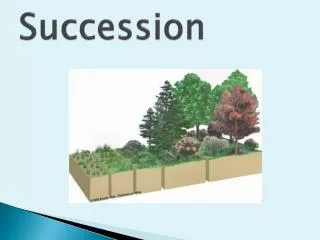
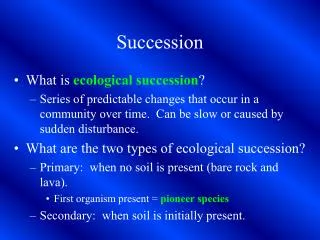
Ecological Succession • The change in an ecosystem that happens when one community is replaced by another as a result of changing biotic and abiotic factors • 2 types: Primary and Secondary
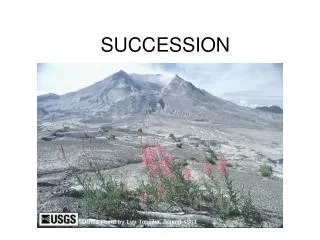
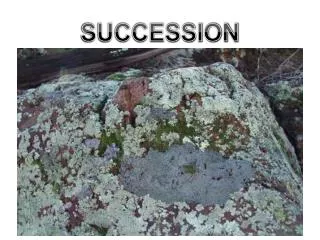
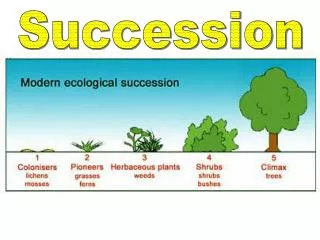
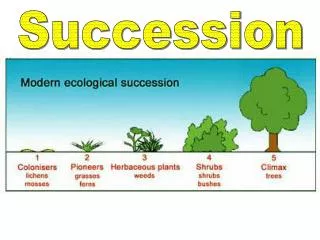
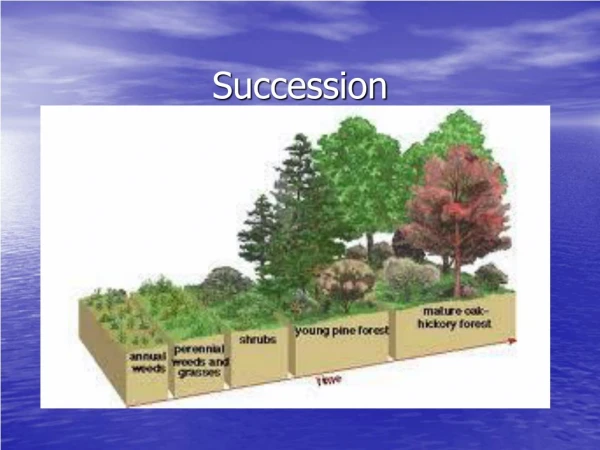
Primary Succession • Establishment of a community in an area where there is no topsoil • Occurs very slowly • Includes pioneer organisms: such as moss, lichens • Helps to break down rocks to make soil
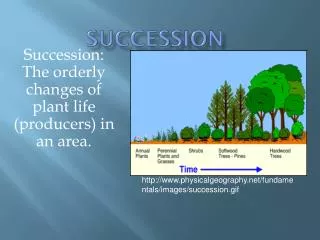
Primary Succession • Then small plants such as ferns, grasses; organisms such as fungi and insects • Finally small trees and shrubs start to grow • Figure 3.3 in textbook • A mature community can develop from bare ground • Climax Community: a stable, mature community that results when there is little change in the types of species
Succession • http://geopolicraticus.wordpress.com/2010/04/30/ecological-succession-in-cultural-geography/
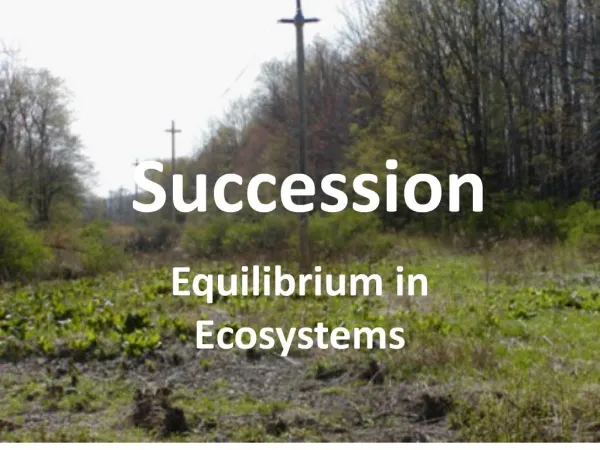
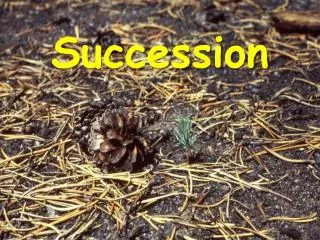
Secondary Succession • Change that happens after a community of organisms have been removed but the soil remains intact • Community changes over time just as in primary succession